
Ipamorelin is one of the most studied growth hormone peptides in preclinical research, and one of the most selectively engineered. It was developed specifically to solve a problem with earlier growth hormone peptides: how to stimulate growth hormone release without also triggering cortisol and other stress hormones that complicated research results and made the findings harder to interpret.
This overview covers what ipamorelin is, how it works, what the research shows, and why it is almost always studied alongside CJC-1295. All research discussed here was conducted in laboratory and animal models unless otherwise noted. Ipamorelin is classified as Research Use Only and is not approved by the FDA for human therapeutic use. For the latest research developments on the ipamorelin and CJC-1295 combination, see CJC-1295 and ipamorelin: latest research.
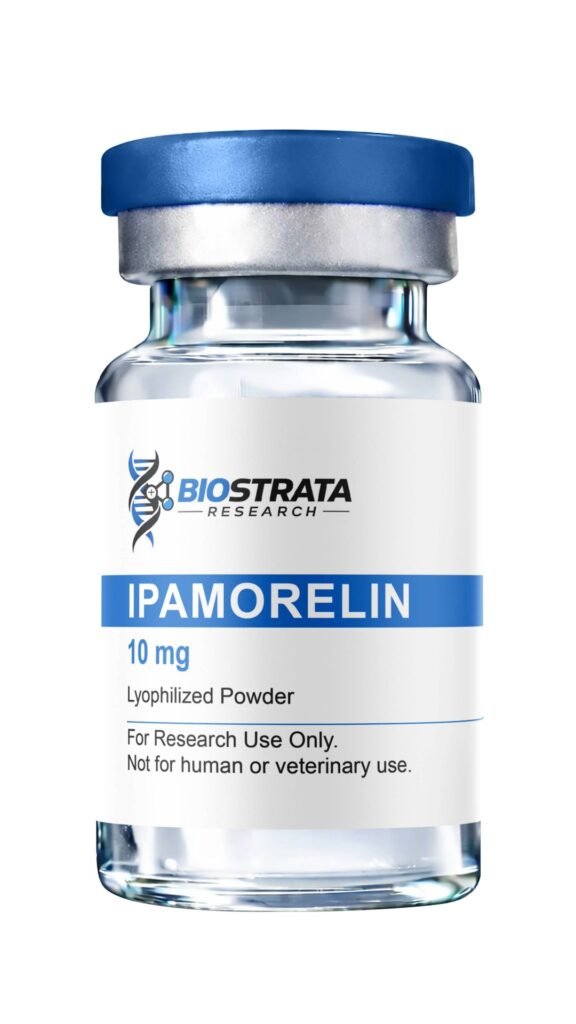
Key Research Facts: Ipamorelin Research Overview
- Ipamorelin is a synthetic 5-amino-acid peptide that tells the pituitary gland to release growth hormone, mimicking the natural signal the body uses during fasting and deep sleep
- Growth hormone declines significantly with age, and ipamorelin research examines what happens to body composition, recovery, bone density, and sleep when that signal is restored
- What makes ipamorelin stand out from earlier growth hormone peptides is that it triggers growth hormone release without also raising cortisol, the stress hormone that counteracts many of growth hormone's effects
- Ipamorelin produces a short growth hormone pulse that peaks around 40 to 60 minutes after administration and clears within a few hours, closely matching how the body naturally releases growth hormone
- Ipamorelin is almost always studied alongside CJC-1295 because the two compounds activate different receptor pathways that produce a larger combined growth hormone response than either achieves alone
What Ipamorelin Is and Why Growth Hormone Matters
Ipamorelin is a synthetic peptide that works by sending a signal to the pituitary gland, the small gland at the base of the brain that controls growth hormone release. When the signal arrives, the pituitary releases a pulse of growth hormone into circulation. That pulse then drives a cascade of effects throughout the body, from muscle preservation and fat metabolism to tissue repair and bone density.
Growth hormone is not just a muscle-building hormone. It is one of the primary biological signals that keeps the body in a repair and maintenance state. It peaks during deep sleep, spikes in response to fasting and exercise, and plays a central role in how the body responds to injury. As growth hormone declines with age, so does the body’s capacity to maintain lean tissue, recover from stress, and repair damage efficiently.
Ipamorelin mimics a naturally occurring hunger signal called ghrelin, which is one of the body’s primary triggers for growth hormone release. When ghrelin rises during fasting, one of the things it does is signal the pituitary to release growth hormone. Ipamorelin activates the same receptor that ghrelin uses, producing the same growth hormone response without requiring the body to be in a fasted state.
Ipamorelin was developed by Novo Nordisk in the late 1990s and has remained the benchmark compound in growth hormone secretagogue research ever since. It is classified as Research Use Only and is not approved for human therapeutic use. For broader context on how hormonal signaling systems work and why growth hormone sits at the center of so many research areas, see hormonal and endocrine signaling research.
What Makes Ipamorelin Different: No Cortisol, Cleaner Results
Before ipamorelin, the most commonly used growth hormone peptides in research were GHRP-6 and GHRP-2. Both did the job of stimulating growth hormone release, but they came with a significant problem that made research results hard to interpret. At the doses needed to produce meaningful growth hormone responses, both compounds also raised cortisol, the body’s primary stress hormone.
That matters because cortisol and growth hormone work in opposite directions on many of the same systems. Growth hormone preserves muscle and promotes fat metabolism. Cortisol breaks down muscle and promotes fat storage. Growth hormone supports tissue repair and recovery. Cortisol impairs it. If a researcher is studying how growth hormone affects body composition or recovery and cortisol is rising at the same time, there is no clean way to know which hormone is driving which effect.
Ipamorelin was engineered specifically to solve this problem. The research that established it as the first selective growth hormone secretagogue showed that it produced growth hormone release with the same potency as GHRP-6 while producing no meaningful cortisol response, even at doses more than 200 times higher than what was needed to trigger a growth hormone pulse. That selectivity is what made ipamorelin the benchmark compound and why it remains the standard research tool for studying growth hormone biology in isolation.
The absence of cortisol elevation also makes ipamorelin research more relevant to sleep biology. Growth hormone and cortisol have opposing effects on sleep quality, and the largest natural growth hormone pulse happens during deep sleep. For research on how growth hormone secretagogues connect to sleep quality, see peptides for sleep.
What the Research Shows: Body Composition, Recovery, and Bone Density
The research areas that follow from ipamorelin’s growth hormone stimulation cover the full range of what growth hormone does in the body. Body composition is the most studied angle. Growth hormone drives fat metabolism and muscle preservation simultaneously, which is why GH decline with age is associated with increasing body fat and decreasing lean mass even in people who maintain their diet and exercise habits. Ipamorelin research has examined whether restoring the growth hormone signal reverses these trends in animal models.
Recovery and tissue repair are a closely related area. Growth hormone is one of the primary signals the body uses to repair muscle, connective tissue, and bone after stress or injury. Research has examined ipamorelin’s effects on recovery metrics in animal models of exercise and injury, looking at whether the growth hormone pulse it produces translates into measurable improvements in tissue repair speed and quality.
Bone density research has also been a focus. Studies in rat models demonstrated effects on bone mineral content following chronic ipamorelin administration, contributing to early interest in growth hormone peptides for bone biology research. This is particularly relevant to aging research, where bone density loss is one of the most significant health consequences of declining growth hormone and IGF-1 levels.
IGF-1, the growth factor the liver produces in response to growth hormone, is the downstream marker most commonly measured in these studies. IGF-1 mediates many of growth hormone’s effects on muscle, bone, and tissue repair, and its elevation following ipamorelin administration has been documented across multiple research models. For how these effects compare in the combination protocol, see CJC-1295 and ipamorelin stack: what the research shows.
The Gut Research: An Unexpected Application
One of the most surprising areas of ipamorelin research has nothing to do with growth hormone, body composition, or recovery. It involves the gut. The same receptor that ipamorelin activates in the pituitary to trigger growth hormone release is also present throughout the gastrointestinal tract, where it plays a role in regulating gut movement and digestion. Because ipamorelin binds that receptor wherever it is expressed, it also engages gut biology alongside its pituitary effects.
Researchers investigated this in the context of a common surgical complication called postoperative ileus. After abdominal surgery, the gut sometimes stops moving normally. Patients cannot eat, recovery stalls, and hospital stays lengthen. It is a significant clinical problem with limited effective treatments. The question researchers asked was whether ipamorelin’s ability to activate gut receptors could help restart normal gut movement after surgery.
Preclinical studies in animal models showed that ipamorelin dose-dependently accelerated gut transit and reversed the motility delays caused by surgery. These findings were compelling enough to advance to human investigation. A Phase II randomized controlled trial studied ipamorelin in bowel resection patients, making it one of the few growth hormone peptides to reach a controlled human clinical trial in a gastrointestinal context.
This research thread matters because it illustrates something important about peptide biology: a compound developed for one purpose frequently turns out to be relevant in entirely different biological systems once researchers follow its receptor distribution. Ipamorelin’s gut research now stands as an independent area of investigation separate from its growth hormone profile. For the complementary growth hormone research profile of the compound most often studied with ipamorelin, see CJC-1295 research overview.
Ipamorelin and CJC-1295: Why They Are Studied Together
If you spend any time reading about ipamorelin, CJC-1295 will almost always appear alongside it. That pairing is not convention. It is based on a straightforward piece of biology about how growth hormone release works in the pituitary gland.
The pituitary releases growth hormone in response to two separate signals. One comes from ghrelin, which is what ipamorelin mimics. The other comes from a different hormone called GHRH, which is what CJC-1295 mimics. Both signals arrive at the same pituitary cells, but through different entry points. When only one signal arrives, you get a growth hormone response. When both arrive at the same time, the two entry points work together to produce a growth hormone pulse substantially larger than either signal produces alone. Researchers describe this as a synergistic effect.
The practical research implication is significant. Combining ipamorelin with CJC-1295 produces more robust growth hormone and IGF-1 responses at lower individual doses of each compound. The pairing also combines ipamorelin’s short pulsatile release, which peaks and clears within hours, with CJC-1295’s longer sustained receptor engagement, producing a growth hormone response that has characteristics of both simultaneously.
This is why the combination is the standard protocol in growth hormone secretagogue research. It more closely approximates the full growth hormone signaling response the body is capable of producing than either compound achieves alone. One active area of investigation in extended protocols is how receptor sensitivity responds to sustained versus pulsatile stimulation over time. For what the research shows on that question across peptide classes, see can you build tolerance to peptides.
FAQs, Ipamorelin Research Overview
What is ipamorelin used for in research?
Ipamorelin is primarily studied for its effects on growth hormone release and the downstream changes that follow: body composition, fat metabolism, muscle preservation, tissue repair, bone density, and sleep quality. It is also studied independently for gastrointestinal motility, where it has reached a Phase II human clinical trial for recovery after abdominal surgery. All research is conducted in laboratory and animal models under a Research Use Only framework.
How is ipamorelin different from other growth hormone peptides?
The key difference is selectivity. Earlier growth hormone peptides like GHRP-6 also raised cortisol, the stress hormone that works against many of the effects growth hormone produces. Ipamorelin triggers growth hormone release without meaningfully raising cortisol, even at doses far above what is needed for a growth hormone response. That clean separation makes it a more useful research tool and has made it the benchmark compound in growth hormone secretagogue research.
Why is ipamorelin always studied with CJC-1295?
Ipamorelin mimics ghrelin, one of the body’s two primary growth hormone signals. CJC-1295 mimics GHRH, the other primary signal. When both signals arrive at the pituitary simultaneously, they work through separate entry points that interact to produce a larger combined growth hormone response than either compound achieves alone. Studying them together produces more robust and physiologically meaningful results than either compound in isolation.
Has ipamorelin been tested in humans?
Ipamorelin has been examined in a Phase II randomized controlled human clinical trial in the context of postoperative ileus, the gut motility complication that follows abdominal surgery. This is separate from its growth hormone research profile, which remains primarily preclinical. The gut trial makes ipamorelin one of the few growth hormone peptides to reach controlled human investigation.
What is ipamorelin’s regulatory status?
Ipamorelin is not approved by the FDA for human therapeutic use and is classified as Research Use Only in the United States. It appears on the WADA Prohibited List, banning its use in competitive sports. For context on how growth hormone peptide research intersects with athletic performance biology, see muscle performance research.
- CONTINUE LEARNING
Explore Related Peptide Topics
Continue building your understanding by exploring related foundational peptide topics.
References & Sources
- Ipamorelin as a Selective Growth Hormone Secretagogue — European Journal of Endocrinology (1998)
- Ipamorelin (Ghrelin Mimetic) in Postoperative Ileus Management — International Journal of Colorectal Disease (2014)
- Growth Hormone Secretagogues and Body Composition Research in Hypogonadal Models — Translational Andrology and Urology (2020)
Disclaimer: BioStrata Research provides materials for laboratory research use only. The information in this article is intended strictly for educational and informational purposes within a research context and should not be interpreted as medical advice, treatment guidance, or product claims for human use.