
Growth hormone is one of the most important hormones in the body for muscle preservation, fat metabolism, recovery, and biological aging. The brain controls its release through a signal called GHRH, but that signal disappears from the bloodstream within minutes. CJC-1295 is a synthetic version of that signal engineered to last nearly a week, giving researchers a tool to study what sustained growth hormone stimulation does to the body over time.
This overview covers what CJC-1295 is, what the research actually shows about its effects, the important difference between CJC-1295 with and without DAC, and why it is almost always studied alongside ipamorelin. All research is conducted in laboratory and animal models unless otherwise noted. CJC-1295 is classified as Research Use Only and has not been approved by the FDA for human therapeutic use. For the complementary growth hormone research profile of the compound most commonly studied with CJC-1295, see ipamorelin research overview.
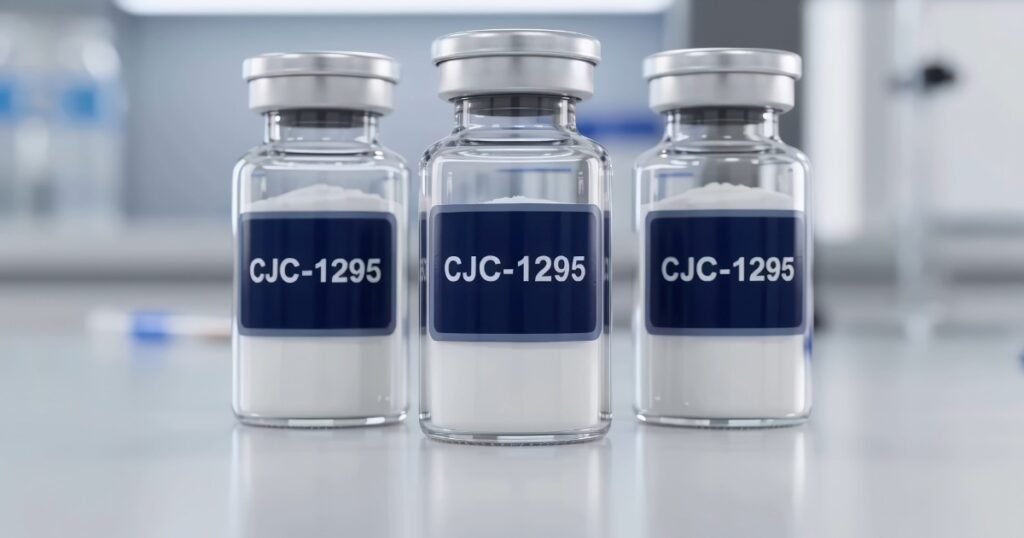
Key Research Facts: CJC-1295 Research Overview
- CJC-1295 is a synthetic version of the signal the brain uses to tell the pituitary gland to release growth hormone, engineered to last days instead of minutes
- A single injection of CJC-1295 produced growth hormone increases of 2 to 10 times above baseline lasting 6 or more days in human clinical studies, and IGF-1 increases lasting 9 to 11 days
- The key engineering innovation is a modification called DAC that allows CJC-1295 to attach to a blood protein and stay active for 6 to 8 days instead of clearing in minutes like the natural signal does
- CJC-1295 without DAC, also called Modified GRF, has a 30-minute half-life and produces a completely different research profile from CJC-1295 with DAC, the two are frequently confused but are not the same compound
- CJC-1295 is almost always studied alongside ipamorelin because the two compounds activate different growth hormone pathways that work together to produce a larger combined response than either achieves alone
What CJC-1295 Is and What Growth Hormone Actually Does
CJC-1295 is a synthetic version of a signal called Growth Hormone-Releasing Hormone, or GHRH. In the body, GHRH is produced in the hypothalamus, a region of the brain that acts as the master control center for hormone production. When GHRH travels to the pituitary gland, it tells a specific group of cells there to release growth hormone into the bloodstream. CJC-1295 mimics that signal, producing the same growth hormone release through the same receptor.
To understand why this matters, it helps to understand what growth hormone actually does. Growth hormone is one of the primary hormones the body uses to stay in a repair and maintenance state. It drives fat metabolism, helping the body burn stored fat for energy. It preserves and builds lean muscle tissue. It supports tissue repair and recovery after exercise or injury. It influences bone density. And it plays a significant role in sleep quality, with the largest natural growth hormone pulse happening during deep sleep.
Growth hormone production peaks in young adulthood and declines significantly from there. By middle age, growth hormone output is a fraction of what it was at its peak, and that decline tracks closely with the changes most people associate with aging: slower recovery, increasing body fat even with stable diet and exercise habits, declining muscle mass, and reduced sleep quality. CJC-1295 research examines what happens to these systems when the growth hormone signal is sustained at higher levels over an extended period. For broader context on how growth hormone fits within the wider landscape of hormonal and endocrine research, see hormonal and endocrine signaling research.
For broader context on how growth hormone fits into the longevity and biological aging research landscape, see longevity and healthy aging research.
The DAC Technology: Why CJC-1295 Lasts So Long
The natural GHRH signal the brain produces has a major limitation as a research tool: it disappears from the bloodstream within minutes. An enzyme in the blood called DPP-4 breaks it down almost immediately after release. This makes natural GHRH impractical for any research protocol that needs sustained growth hormone stimulation over hours or days.
CJC-1295 solves this in two ways. First, it swaps out four amino acids in the original GHRH sequence at positions that DPP-4 targets, making it resistant to that enzymatic breakdown. Second, it adds a modification called a Drug Affinity Complex, or DAC, that allows it to attach to albumin, the most abundant protein in blood plasma, once it enters the bloodstream.
Here is why the albumin attachment matters. Albumin circulates in the blood for about 19 days before being replaced. When CJC-1295 bonds to albumin, it hitches a ride on that long-lived protein. Instead of being broken down or filtered out by the kidneys within minutes, CJC-1295 stays in circulation for 6 to 8 days, continuously stimulating the GHRH receptor and sustaining growth hormone output across that entire window from a single injection.
Importantly, research has shown that despite this sustained stimulation, the natural pulsatile pattern of growth hormone release is preserved. The body still releases growth hormone in rhythmic pulses throughout the day and night. CJC-1295 raises the baseline and the peak of those pulses rather than replacing the rhythm with a flat, continuous elevation. For context on why some compounds maintain their effects over time while others lose potency, see why some peptides stop working: what’s actually happening.
CJC-1295 with DAC vs Without DAC: Two Very Different Compounds
One of the most persistent sources of confusion in CJC-1295 research is the difference between CJC-1295 with DAC and CJC-1295 without DAC. These two compounds are frequently mentioned interchangeably but they produce fundamentally different research profiles and should never be treated as equivalent.
CJC-1295 with DAC is the compound described above: albumin binding, 6 to 8 day half-life, sustained growth hormone elevation over nearly a week from a single dose. This is the version studied in the human clinical trials and the one most people mean when they say CJC-1295.
CJC-1295 without DAC is more accurately called Modified GRF, or Mod GRF. It shares the same underlying amino acid structure with the same DPP-4 resistant substitutions, but without the albumin-binding modification. That means it clears from the bloodstream within about 30 minutes. Instead of sustained week-long growth hormone elevation, it produces a short, sharp growth hormone pulse that peaks within an hour and resolves within a few hours. That is a completely different research tool for a completely different experimental question.
Modified GRF is actually better suited for studying pulsatile growth hormone dynamics and is frequently used in timed combination protocols with ipamorelin, where both signals arrive at the pituitary simultaneously to produce a synergistic pulse. CJC-1295 with DAC is better suited for studying the downstream effects of prolonged growth hormone and IGF-1 elevation over days. Choosing between them depends entirely on what the research protocol is designed to measure. For research on how growth hormone biology connects to body composition and metabolic outcomes, see peptides and weight loss.
What the Human Research Actually Shows
CJC-1295 has more human clinical data behind it than most research peptides. Two randomized, placebo-controlled, double-blind studies conducted in healthy adults aged 21 to 61 and published in the Journal of Clinical Endocrinology and Metabolism in 2006 produced the primary human pharmacokinetic and pharmacodynamic dataset for the compound.
The findings were significant. A single subcutaneous injection of CJC-1295 produced dose-dependent increases in mean plasma growth hormone concentrations of 2 to 10 times above baseline, lasting 6 or more days. IGF-1 concentrations increased by 1.5 to 3 times above baseline, with those elevations lasting 9 to 11 days. With multiple doses administered weekly or biweekly, mean IGF-1 levels remained elevated above baseline for up to 28 days. The estimated half-life across subjects was 5.8 to 8.1 days. No serious adverse reactions were reported at the doses studied.
These are meaningful numbers. Most research peptides produce their effects and clear within hours. CJC-1295 produced measurable growth hormone and IGF-1 elevation lasting days to weeks from a single dose, in human subjects, in a controlled trial. That depth of human pharmacokinetic data is rare in the research peptide space and is part of what has sustained interest in CJC-1295 as a research tool.
Clinical development for therapeutic use was subsequently discontinued after a trial subject death that the attending physician concluded was most likely due to pre-existing coronary artery disease unrelated to CJC-1295. Research was terminated as a precaution and the compound has not completed the clinical development pathway required for FDA approval. For context on how growth hormone research connects to healing and regenerative biology, see peptides for healing and regenerative research.
Why CJC-1295 Is Almost Always Studied With Ipamorelin
CJC-1295 and ipamorelin are the most commonly co-studied growth hormone peptides in research, and the reason comes down to how the pituitary releases growth hormone. The pituitary responds to two separate signals. CJC-1295 mimics one of them, GHRH, which tells the pituitary to release growth hormone through one signaling pathway. Ipamorelin mimics the other, ghrelin, which tells the pituitary to release growth hormone through a completely separate pathway.
When both signals arrive at the pituitary at the same time, something important happens. The two pathways interact and amplify each other, producing a growth hormone pulse substantially larger than what either signal achieves on its own. Researchers describe this as a synergistic effect, and it is the primary reason the combination is so widely used in growth hormone research protocols.
The pairing also combines two different pharmacokinetic profiles in a complementary way. CJC-1295 with DAC provides sustained background GHRH receptor stimulation across days. Ipamorelin provides a sharp, timed growth hormone pulse at the point of administration. Together they produce both a sustained elevated baseline and defined peaks, a profile that more closely approximates the full range of growth hormone dynamics the body naturally uses than either compound produces alone.
For researchers designing growth hormone research protocols, the combination is considered the standard approach because it produces the most robust and physiologically meaningful results. CJC-1295 is not currently in the BioStrata Research catalog. For research-grade compounds in the metabolic and hormonal research category, see tirzepatide and browse the BioStrata Research shop for available compounds.
FAQs, CJC-1295 Research Overview
What is CJC-1295 and what is it studied for?
CJC-1295 is a synthetic version of the brain signal that tells the pituitary gland to release growth hormone. It is engineered to last 6 to 8 days in the bloodstream rather than clearing in minutes like the natural signal. Research has examined its effects on growth hormone and IGF-1 output, body composition, muscle preservation, fat metabolism, recovery, bone density, and biological aging. It has human clinical trial data showing sustained growth hormone and IGF-1 elevation lasting up to 28 days with multiple doses.
What is the difference between CJC-1295 with and without DAC?
CJC-1295 with DAC binds albumin in the bloodstream and has a half-life of 6 to 8 days, producing sustained growth hormone elevation over nearly a week from a single dose. CJC-1295 without DAC, more accurately called Modified GRF, has a 30-minute half-life and produces a short pulsatile growth hormone response that resolves within hours. They are built on the same underlying structure but produce fundamentally different research profiles and are suited for different experimental questions.
Has CJC-1295 been tested in humans?
Yes. Two randomized placebo-controlled double-blind studies published in the Journal of Clinical Endocrinology and Metabolism in 2006 documented dose-dependent growth hormone increases of 2 to 10 times above baseline lasting 6 or more days, and IGF-1 increases of 1.5 to 3 times lasting 9 to 11 days, from a single injection in healthy adult subjects. Clinical development for therapeutic use was subsequently discontinued after a precautionary trial termination.
Why is CJC-1295 studied with ipamorelin?
CJC-1295 activates the GHRH receptor. Ipamorelin activates the ghrelin receptor. Both receptors sit on the same pituitary cells but operate through separate signaling pathways. Activating both simultaneously produces a synergistic growth hormone pulse larger than either compound achieves alone. The combination is the standard protocol in growth hormone secretagogue research because it produces more robust and physiologically meaningful results than either compound in isolation.
Is CJC-1295 legal?
CJC-1295 is not approved by the FDA for human therapeutic use and is classified as Research Use Only in the United States. It appears on the WADA Prohibited List under Section S2, banning its use in competitive sports. Clinical development for therapeutic use was discontinued and the compound has not completed the approval pathway required for pharmaceutical authorization. For a full overview of how research peptides are classified under US law, see are peptides legal in the United States.
- CONTINUE LEARNING
Explore Related Peptide Topics
Continue building your understanding by exploring related foundational peptide topics.
References & Sources
- CJC-1295 and Prolonged Growth Hormone and IGF-1 Secretion in Healthy Adults — Journal of Clinical Endocrinology & Metabolism (2006)
- Pulsatile Growth Hormone Secretion During Continuous CJC-1295 Stimulation — Journal of Clinical Endocrinology & Metabolism (2006)
- Once-Daily CJC-1295 Administration and Growth Normalization in a GHRH Knockout Mouse Model — American Journal of Physiology: Endocrinology and Metabolism (2006)
Disclaimer: BioStrata Research provides materials for laboratory research use only. The information in this article is intended strictly for educational and informational purposes within a research context and should not be interpreted as medical advice, treatment guidance, or product claims for human use.