
Peptides for muscle recovery and performance research represent one of the most active areas of preclinical biology today. Compounds like BPC-157, TB-500, CJC-1295, and IGF-1 LR3 target distinct nodes of the muscle repair and adaptation system — from angiogenesis and cell migration to growth hormone signaling and satellite cell activation — making them widely studied tools in laboratory research settings.
Understanding how these signaling molecules interact with repair pathways, the GH/IGF-1 axis, and mitochondrial function is essential context for any serious researcher. If you’re new to peptide science, start with What Are Peptides? before diving into compound-specific mechanisms — or explore How Peptides Work at the Cellular Level for a deeper look at receptor signaling and downstream effects.
If you’re new to peptide science, start with What Are Peptides? or explore How Peptides Work at the Cellular Level to understand how these signaling pathways function.
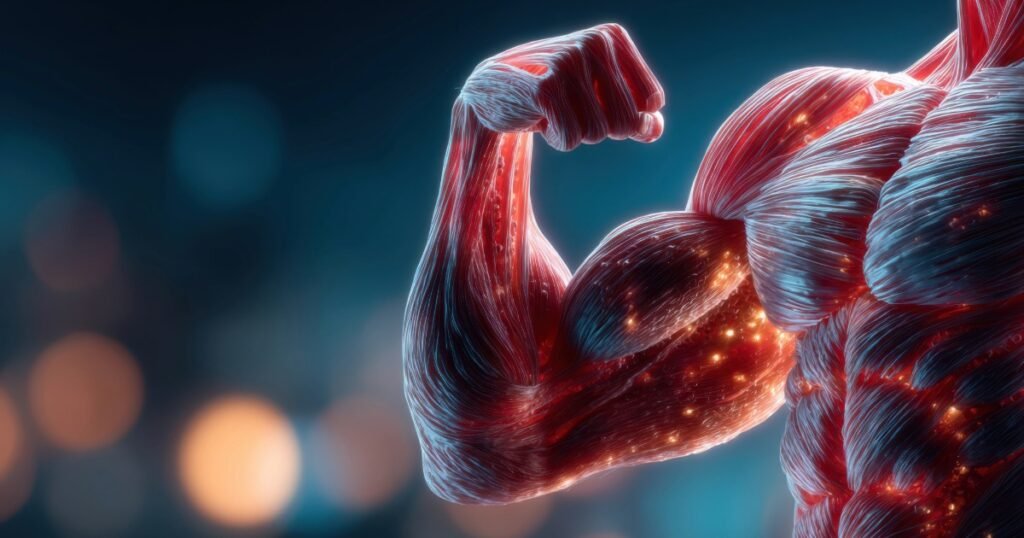
Muscle & Performance Research Framework
- Tissue repair and angiogenesis — BPC-157 is studied for VEGF upregulation and accelerated blood vessel formation into damaged muscle and tendon tissue
- Growth hormone axis signaling — CJC-1295 and Ipamorelin are researched for stimulating pituitary GH release and downstream IGF-1 production
- Satellite cell activation — IGF-1 LR3 is studied for direct effects on muscle stem cell proliferation and the mTOR cascade driving hypertrophy in animal models
- Mitochondrial efficiency and metabolic performance — MOTS-C is a mitochondria-derived peptide researched for AMPK activation and improved exercise capacity in preclinical models
- Cell migration and connective tissue recovery — TB-500 is studied for actin-regulating properties that accelerate repair cell migration and reduce inflammatory signaling at injury sites
Why Peptides Are Central to Muscle & Performance Research
Muscle tissue is one of the most peptide-dependent systems in the body. Every phase of the adaptation cycle — from the mechanical stress of exercise, to the inflammatory response that follows, to the repair and rebuilding process — is coordinated by peptide signaling. Growth factors, cytokines, and repair peptides communicate between muscle fibers, connective tissue, and the vascular system to orchestrate recovery.
This is why researchers don’t study a single “performance peptide” — they study specific compounds that target distinct parts of this system. BPC-157 targets tissue repair and angiogenesis. TB-500 targets cell migration and flexibility. CJC-1295 and Ipamorelin target growth hormone release. MOTS-C targets mitochondrial efficiency. IGF-1 LR3 acts directly downstream on muscle protein synthesis. Each compound operates on a different node of the same biological network.
For a foundational understanding of how these signaling molecules interact with receptors and trigger downstream effects, see our guide to How Peptides Work at the Cellular Level.
BPC-157 — Tissue Repair & Tendon Research
BPC-157 (Body Protection Compound 157) is a 15-amino acid peptide derived from a sequence found in human gastric juice. It is one of the most studied compounds in healing and regenerative research, with particular focus on tendon, ligament, and muscle tissue repair in preclinical models.
The primary mechanism studied is its effect on angiogenesis — specifically upregulation of VEGF (vascular endothelial growth factor), which promotes new blood vessel formation into damaged tissue. Without adequate blood supply, tissue repair stalls. BPC-157’s apparent ability to accelerate vascularization is why researchers consider it highly relevant to recovery biology. Animal studies have also documented accelerated healing of Achilles tendon transections, muscle tears, and ligament injuries.
BPC-157 also interacts with the nitric oxide system and has been studied for tendon-to-bone healing — one of the most mechanically complex repair processes in musculoskeletal biology. For performance researchers, this makes BPC-157 most relevant to connective tissue repair rather than direct muscle hypertrophy. Explore the full compound profile in our BPC-157 Research Overview, or browse BPC-157 10mg in our research catalog.
TB-500 (Thymosin Beta-4) — Flexibility, Cell Migration & Systemic Recovery
TB-500 is a synthetic version of Thymosin Beta-4, a naturally occurring peptide present in virtually every cell in the human body. Its primary biological role involves actin regulation — actin is the structural protein responsible for cell shape, movement, and contraction. This makes TB-500 mechanistically distinct from BPC-157, and why researchers often study both compounds when examining the full tissue repair cycle.
In muscle and performance research, TB-500’s most studied properties are cell migration and anti-inflammatory signaling. When tissue is damaged, repair cells must migrate to the injury site rapidly. TB-500 has been studied for its ability to accelerate this migration process in both muscle and endothelial cells. Several animal studies have documented reduced inflammation and improved healing outcomes in muscle injury models, with effects attributed to its influence on actin dynamics in connective tissue.
TB-500 has also been examined for effects on muscle flexibility and range of motion — thought to be related to its broader role in regulating cytoskeletal structure across multiple tissue types. For a deeper look at the compound, see our TB-500 Research Overview.
CJC-1295 & Ipamorelin — Growth Hormone Secretagogues in Performance Research
CJC-1295 and Ipamorelin are two of the most researched growth hormone secretagogues (GHS) in preclinical performance science — and the most commonly studied together. CJC-1295 is a GHRH (growth hormone-releasing hormone) analog that stimulates the pituitary gland to produce and release growth hormone. Ipamorelin is a selective ghrelin mimetic that triggers GH release through a separate receptor pathway. Used in combination, they target two distinct stimulation points on the same axis, producing a more sustained GH pulse in animal models than either compound alone.
In research settings, the CJC-1295 and Ipamorelin stack is studied primarily for its effects on lean mass development, recovery speed, and sleep quality — all downstream consequences of elevated GH and IGF-1 activity. Unlike direct IGF-1 analogs such as IGF-1 LR3, these compounds work upstream by stimulating the body’s own GH production rather than introducing exogenous growth factor directly. This makes them a distinct and complementary research category within the GH/IGF-1 axis.
Ipamorelin is particularly notable for its receptor selectivity — it stimulates GH release with minimal effect on cortisol or prolactin, making it one of the cleaner GHS compounds studied in animal models. For foundational context on how growth hormone signaling connects to muscle adaptation, see our guide to How Peptides Work at the Cellular Level.
IGF-1 LR3 — Growth Factor Signaling & Muscle Protein Synthesis
IGF-1 (Insulin-Like Growth Factor 1) is a naturally occurring peptide hormone produced primarily in the liver in response to growth hormone signaling. It is one of the primary downstream mediators of muscle protein synthesis — when GH stimulates the liver to produce IGF-1, IGF-1 travels to muscle tissue and directly activates satellite cells and the PI3K/Akt/mTOR cascade responsible for hypertrophy in animal models.
IGF-1 LR3 is a modified analog with a significantly extended half-life. Natural IGF-1 is rapidly cleared from circulation, limiting its research utility. The LR3 modification extends half-life from minutes to several hours, making it more practical as a laboratory compound. In preclinical studies, IGF-1 LR3 is studied for satellite cell proliferation — the muscle stem cells responsible for repair and growth — and for direct effects on muscle fiber hypertrophy independent of upstream GH signaling.
This positions IGF-1 LR3 as a distinct research tool from CJC-1295 and Ipamorelin, which work upstream to stimulate GH release. IGF-1 LR3 acts downstream, directly at the tissue level. For researchers studying the full GH secretagogue picture, our Ipamorelin Research Overview covers the upstream signaling mechanisms in detail.
FAQ — Peptide Research for Muscle & Performance
What peptides are most studied for muscle recovery research?
BPC-157 and TB-500 are the most extensively researched peptides for tissue repair and recovery. BPC-157 focuses on angiogenesis and tendon healing via VEGF upregulation. TB-500 focuses on actin regulation, cell migration, and anti-inflammatory signaling. They target different mechanisms within the same repair cycle, which is why researchers frequently study them together.
What is the CJC-1295 and Ipamorelin stack studied for?
CJC-1295 and Ipamorelin are studied in combination for their synergistic effects on growth hormone release. CJC-1295 acts on GHRH receptors while Ipamorelin acts on ghrelin receptors — stimulating two separate pathways on the same axis. Preclinical research focuses on lean mass development, recovery speed, and sleep quality as downstream effects of elevated GH and IGF-1 activity.
How does IGF-1 LR3 differ from regular IGF-1?
IGF-1 LR3 is a modified analog with a significantly extended half-life — hours rather than minutes. This makes it more practical as a research compound. It acts downstream of growth hormone, directly stimulating satellite cell activation and the mTOR cascade associated with muscle protein synthesis in animal models.
What makes MOTS-C unique among performance research peptides?
MOTS-C is encoded by mitochondrial DNA rather than nuclear DNA, making it structurally unlike any other research peptide. It is studied primarily for AMPK activation — the same energy-sensing pathway triggered by exercise — and for improvements in insulin sensitivity, fatty acid oxidation, and exercise capacity in preclinical models.
Are these peptides approved for human use?
No. BPC-157, TB-500, CJC-1295, Ipamorelin, IGF-1 LR3, and MOTS-C are not FDA-approved for human consumption or therapeutic use. All research on these compounds is conducted in preclinical, laboratory settings. They are supplied strictly for research use only (RUO).
Where can I find research-grade versions of these compounds?
BioStrata Research supplies BPC-157, TB-500, CJC-1295, Ipamorelin, and MOTS-C as research-grade compounds with full COA documentation. Browse our Healing & Regenerative Research and Metabolic Research catalogs.
- CONTINUE LEARNING
Explore Related Peptide Topics
Continue building your understanding by exploring related foundational peptide topics.
References & Sources
- Modulatory Effect of BPC-157 on Angiogenesis in Muscle and Tendon Healing — Journal of Physiology and Pharmacology
- BPC-157 Promotes Tendon Healing Through Cell Survival and Migration — Journal of Applied Physiology
- Emerging Use of BPC-157 in Orthopaedic Sports Medicine: A Systematic Review — HSS Journal
- Thymosin β4: A Multifunctional Regenerative Peptide — Expert Opinion on Biological Therapy
- Muscle Injury-Induced Thymosin β4 as a Chemoattractant for Myoblasts — Journal of Cell Science
- MOTS-c Promotes Metabolic Homeostasis and Reduces Obesity and Insulin Resistance — Cell Metabolism
- Exercise, Mitohormesis, and MOTS-c — Frontiers in Physiology
- Therapeutic Peptides in Orthopaedics: Applications, Challenges, and Future Directions — JAAOS
All references are provided for educational and research context only. Compounds discussed are investigational and not approved for general therapeutic use.