
SNAP-8 is one of the most misunderstood peptides in the skin research space. It targets the same biological pathway as Botox, which leads people to assume it works the same way. It does not. Botox is an injected neurotoxin that permanently disables nerve terminals. SNAP-8 is a topical peptide that temporarily competes with a single protein in the same pathway. Same target, completely different mechanism, completely different risk and reversibility profile.
This overview cuts through the confusion. It covers what SNAP-8 actually is, how it works, what the research shows, and how it compares to both Botox and Argireline, the peptide it was designed to improve upon. For research on the complementary structural skin compound most commonly studied alongside SNAP-8, see GHK-Cu research overview.
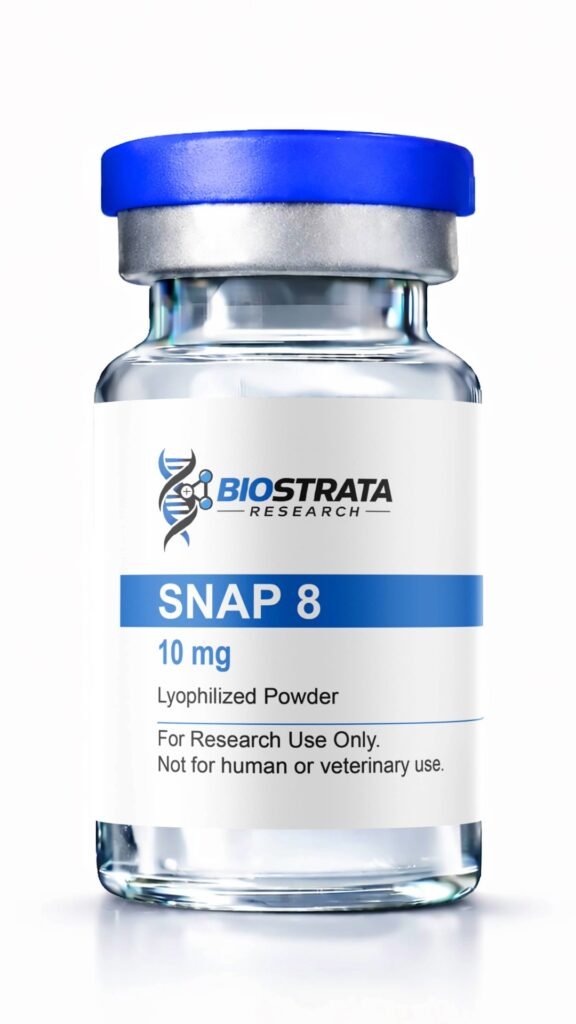
Key Research Facts: SNAP-8 Research Overview
- SNAP-8 is a synthetic 8-amino-acid peptide that targets the same biological pathway as Botox, the nerve signaling mechanism that triggers facial muscle contraction, but through a completely different and reversible mechanism
- Botox destroys the protein that triggers muscle contraction permanently, SNAP-8 competes with that protein temporarily and reversibly, the two are fundamentally different in how they work and how long they last
- SNAP-8 is a topical research compound, it is not injected, it is studied in formulation research for skin serums, creams, and cosmeceutical delivery systems
- In vitro studies comparing SNAP-8 to Argireline, the most commonly used peptide in this category, found SNAP-8 achieved approximately 30% greater reduction in the target protein complex at equivalent concentrations
- SNAP-8 is classified as Research Use Only and is not approved by the FDA as a drug or cosmetic treatment, though related compounds appear widely in commercial skincare products
Can SNAP-8 Do What Botox Does? The Honest Answer
The short answer is no. SNAP-8 cannot do what Botox does, and anyone claiming otherwise is overstating what the research shows. Botox paralyzes the muscle completely. The nerve cannot fire, the muscle cannot contract, and the result is visible and immediate. SNAP-8 moderates the contraction signal. The muscle still moves, just with a reduced signal strength. Those are not the same outcome, and no topical peptide currently in research produces results equivalent to an injectable neurotoxin.
That said, SNAP-8 is not just marketing language. It targets a real biological mechanism, operates on the same pathway as Botox through a completely different and far gentler approach, and has in vitro research supporting its ability to reduce the protein interaction that drives muscle contraction signals. The question is not whether it works at all. The question is what it actually does, how significant that effect is, and whether a topical compound can deliver enough of it to the right location to produce visible results.
What the research establishes clearly is the mechanism. SNAP-8 competes with a protein called SNAP-25 that is essential for triggering acetylcholine release at the neuromuscular junction, the point where nerve signals cross to muscle tissue. When SNAP-8 occupies the binding sites that SNAP-25 uses, the contraction signal is moderated. Not eliminated. Moderated. The effect is reversible, concentration-dependent, and limited to where the compound is applied.
What the research does not yet establish definitively is how much of that in vitro effect translates to visible outcomes in human skin when applied topically, because the compound faces a significant delivery challenge getting through the skin barrier to reach the neuromuscular junction in sufficient concentration. That gap between mechanism and clinical outcome is where most of the honest debate about this compound class sits. For a broader look at how cosmeceutical peptide research is structured and evaluated, see peptides for skin care.
How SNAP-8 Works: The SNARE Complex Explained Simply
To understand SNAP-8 you need to understand one biological mechanism: how nerves tell muscles to contract. When a nerve impulse arrives at a muscle fiber, it does not jump directly across the gap. Instead, the nerve terminal releases a chemical messenger called acetylcholine into the space between the nerve and the muscle. The muscle detects that chemical signal and contracts in response.
The release of acetylcholine is controlled by a group of proteins called the SNARE complex. Think of it as a molecular zipper. Three proteins, SNAP-25, syntaxin, and synaptobrevin, zip together to pull acetylcholine-containing pouches up to the nerve terminal membrane and release their contents. No zipper, no acetylcholine release. No acetylcholine, no muscle contraction.
SNAP-8 mimics a portion of the SNAP-25 protein closely enough to compete for the binding sites that the zipper uses. When SNAP-8 occupies those sites, the zipper forms less efficiently. Less efficient zipper formation means less acetylcholine released per nerve signal. Less acetylcholine means a moderated contraction signal reaching the muscle. Over time, fewer and weaker contractions mean less mechanical stress on the overlying skin and potentially less deepening of expression lines.
The key word is competes. SNAP-8 does not destroy the SNAP-25 protein. It temporarily occupies binding sites in a concentration-dependent way. When SNAP-8 levels at the target site decrease, as topically applied compounds naturally do over time, the zipper resumes normal assembly and muscle contraction returns to baseline. The effect is reversible by design. For context on how synthetic peptides are engineered to mimic and compete with natural proteins like SNAP-25, see how peptides are created: natural vs synthetic.
SNAP-8 vs Botox: The Same Target, Completely Different Mechanism
The comparison between SNAP-8 and Botox is the most common source of confusion about this compound, and it needs to be addressed directly. Both target the SNARE complex and the acetylcholine release pathway. That is where the similarity ends.
Botox, botulinum toxin, works by cleaving SNAP-25, the same protein SNAP-8 competes with. But where SNAP-8 competes temporarily and reversibly, Botox destroys the protein enzymatically and permanently. The nerve terminal cannot release acetylcholine because the release mechanism has been eliminated, not modulated. The muscle cannot contract. The effect lasts three to six months, until the nerve terminal regenerates and produces new SNAP-25. Botox is one of the most potent biological toxins known and its effects within its zone of action are total.
SNAP-8 moderates the signal. Botox eliminates it. SNAP-8 is topically applied. Botox is injected directly into target muscles by a trained clinician. SNAP-8 produces a reversible, dose-dependent reduction in contraction signaling. Botox produces complete paralysis of the treated muscle for months. These are not two versions of the same thing. They are fundamentally different interventions operating on the same underlying biology.
The research interest in SNAP-8 comes precisely from this difference. Researchers studying topical alternatives to injectable approaches need compounds that operate on the same pathway but with a safety and reversibility profile appropriate for cosmeceutical formulation. SNAP-8 fits that research need. Botox does not belong in that category. For context on how longevity-focused skin research examines compounds that support skin biology over time through multiple mechanisms, see longevity and healthy aging research.
SNAP-8 vs Argireline: Why Two Extra Amino Acids Matter
Argireline, also known as acetyl hexapeptide-3, was the first peptide developed to target SNARE complex formation through competitive inhibition of SNAP-25. It has been in commercial skincare since the early 2000s and has accumulated a substantial body of in vitro and formulation research. SNAP-8 was developed as a direct structural successor with one specific improvement: two additional amino acids extending the sequence from six to eight residues.
Those two amino acids are not cosmetic changes. They change how well the peptide binds to the SNAP-25 target site. The effectiveness of a competitive inhibitor depends on how many contact points it makes with the binding region it is competing for. A longer peptide sequence that matches the target region more completely creates more contact points and binds with greater affinity, meaning it takes less of the compound to occupy the same proportion of binding sites.
In vitro studies comparing the two compounds at equivalent concentrations found that SNAP-8 achieved approximately 30% greater reduction in SNARE complex formation than Argireline. That is a meaningful difference for what appears to be a minor structural modification, and it illustrates one of the foundational principles of peptide research: small sequence changes can produce significant changes in biological activity at the target site.
For commercial skincare consumers, Argireline is far more widely available. For formulation researchers working at the research-grade level, SNAP-8 represents the more potent option in this compound class at equivalent concentrations. For context on how neurological and nerve-muscle signaling research intersects with peptide science more broadly, see cognitive and neurological research.
Formulation Research, GHK-Cu Pairing, and What SNAP-8 Is Studied With
SNAP-8’s physicochemical profile makes it practical for topical formulation research. It is water-soluble, stable across a broad pH range, and compatible with aqueous serums, emulsions, and gel matrices. In formulation research it is typically studied at concentrations between 3 and 10 percent in the final preparation, with higher concentrations associated with greater competitive inhibition of SNARE complex activity in in vitro models.
GHK-Cu is the most frequently paired compound in SNAP-8 research, and the pairing is mechanistically logical. SNAP-8 addresses the neuromuscular signaling dimension of skin biology: moderating the contraction signals that cause repeated mechanical stress on overlying skin. GHK-Cu addresses the structural dimension: stimulating collagen and elastin synthesis, supporting extracellular matrix integrity, and promoting tissue repair. One compound works on the nerve signal side. The other works on the tissue repair and maintenance side. They target different biological problems through independent mechanisms, which is why studying them together produces research data that neither compound generates alone.
This pairing reflects a broader principle in cosmeceutical formulation research. Expression lines have two contributing factors: the mechanical stress of repeated muscle contraction over time, and the declining structural support of the skin as collagen and elastin diminish with age. A compound that addresses only one of those factors addresses only part of the problem. The SNAP-8 and GHK-Cu combination in research protocols is designed to investigate whether addressing both simultaneously produces measurably different outcomes than addressing either alone.
BioStrata Research supplies SNAP-8 and GLOW as research-grade lyophilized compounds with full batch COA documentation for laboratory and formulation research use only.
FAQs, SNAP-8 Research Overview
Is SNAP-8 basically Botox in a cream?
No, and this is the most important clarification about this compound. Botox destroys the SNAP-25 protein that controls muscle contraction, permanently disabling the nerve terminal for months. SNAP-8 temporarily competes with that same protein for binding sites, moderating rather than eliminating the contraction signal. The effect is reversible, dose-dependent, and topically applied rather than injected. They share a biological target but are fundamentally different in mechanism, reversibility, potency, and application method.
How is SNAP-8 different from Argireline?
Both are synthetic peptides that target the same SNAP-25 binding site through competitive inhibition. SNAP-8 has eight amino acids and Argireline has six. The additional two residues in SNAP-8 provide more contact points at the target site, improving binding affinity. In vitro studies have found SNAP-8 achieves approximately 30% greater reduction in SNARE complex formation at equivalent concentrations, making it the more potent of the two at the same dose.
Does SNAP-8 actually work for wrinkles?
The research on SNAP-8 is primarily in vitro, meaning conducted in cell culture models rather than in human subjects. In vitro studies confirm the competitive inhibition mechanism works as described. Human clinical trial data on SNAP-8 specifically as a standalone topical compound is limited. Related compounds in this category including Argireline have more extensive formulation research behind them. SNAP-8 is a research compound and its real-world cosmetic effects in human subjects are not yet definitively established through controlled trials.
Is SNAP-8 safe?
SNAP-8 has a well-characterized safety profile in vitro and in formulation research. It is non-toxic at concentrations used in cosmeceutical research and does not produce the surrounding tissue effects associated with injectable neurotoxin approaches. As a topical compound it does not enter systemic circulation at meaningful concentrations. For a broader look at how research peptide safety is evaluated and what RUO classification means for compounds like SNAP-8, see are peptides safe.
What is SNAP-8 most commonly studied with?
GHK-Cu is the most frequently paired compound in SNAP-8 formulation research. SNAP-8 targets the neuromuscular signaling dimension of expression line biology by moderating contraction signals. GHK-Cu targets the structural dimension through collagen synthesis, elastin support, and tissue repair. The two mechanisms are independent and complementary, making them a logical pairing for researchers studying multiple aspects of skin aging biology simultaneously.
For researchers and clinicians seeking professional guidance on aesthetic or dermatological applications, Find a Top Doc provides access to board-certified healthcare providers across dermatology and aesthetic specialties.
- CONTINUE LEARNING
Explore Related Peptide Topics
Continue building your understanding by exploring related foundational peptide topics.
References & Sources
- Molecular Mechanisms of Neurotransmitter Release — Annual Review of Biophysics (2022)
- Neuromuscular Junction Physiology and Synaptic Transmission — StatPearls / NCBI Bookshelf (2025)
- SNARE Complex Function in Neuronal and Sensory Cells — Frontiers in Synaptic Neuroscience (2013)
- Botulinum Neurotoxin Cleavage of SNAP-25 and Synaptic Inhibition Mechanisms — Journal of Biological Chemistry (1993)
- SNARE Proteins and Regulated Vesicle Exocytosis — Proceedings of the National Academy of Sciences (2000)
Disclaimer: BioStrata Research provides materials for laboratory research use only. The information in this article is intended strictly for educational and informational purposes within a research context and should not be interpreted as medical advice, treatment guidance, or product claims for human use.