
Melanotan II is one of the most talked-about peptides online and one of the most misunderstood. People know it as a tanning peptide. What they often do not know is that it also affects appetite, weight, and other biological systems through the same set of receptors it uses to trigger melanin production in the skin. That broad range of effects is what makes it interesting to researchers and what also makes it important to understand accurately before working with it.
This overview covers what Melanotan II is, how it works, what the research shows across its main applications, and what the honest safety picture looks like. All content is produced for research and educational purposes. Melanotan II is classified as Research Use Only and has not been approved by the FDA for human therapeutic use. For context on how research peptides are studied and evaluated across different biological systems, see BPC-157 research overview as an example of how preclinical evidence is structured and interpreted.
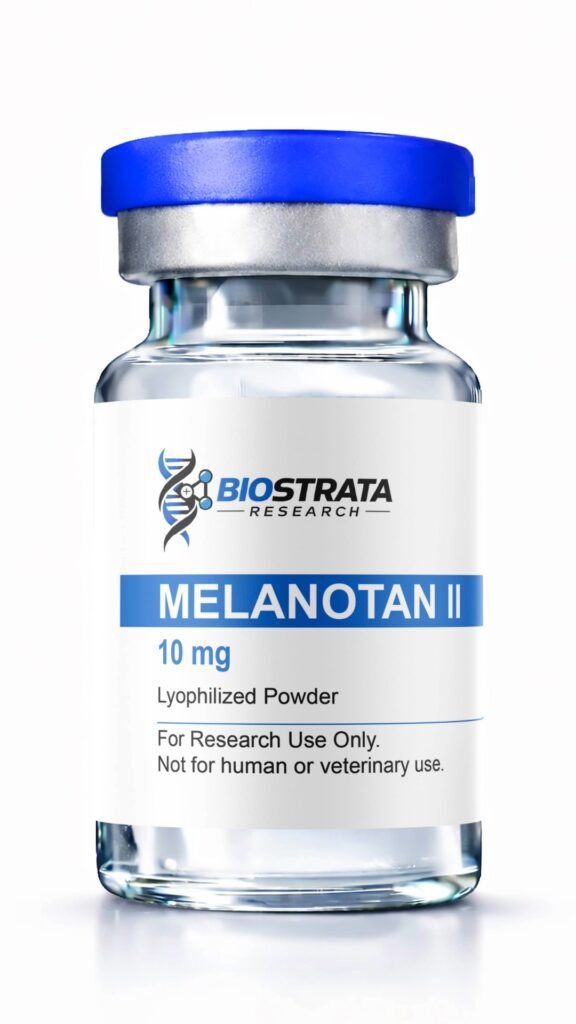
Key Research Facts: Melanotan II Research Overview
- Melanotan II is a synthetic peptide that mimics a hormone the body naturally uses to trigger melanin production, the pigment that gives skin its color and tan
- It was originally developed at the University of Arizona in the 1980s to help fair-skinned people develop a protective tan without dangerous levels of UV exposure
- Beyond tanning, research has documented appetite suppression and reduced food intake in animal models, which is why it is also studied in metabolic and weight research contexts
- Melanotan II is sometimes called the Barbie drug in media coverage due to its tanning and appetite effects, this nickname reflects its social popularity but not its research classification
- Melanotan II is not approved by the FDA for human therapeutic use and carries real documented safety concerns including mole changes and nausea that any researcher should understand clearly
What Melanotan II Is and Where It Came From
Melanotan II is a synthetic peptide developed at the University of Arizona in the 1980s. The researchers who created it had a specific problem to solve: fair-skinned people are at higher risk of UV-induced skin damage and skin cancer, but the natural protective mechanism the body uses against UV exposure, producing melanin pigment to darken the skin, works less efficiently in people with lighter skin. The goal was to find a way to trigger that protective tanning response without requiring dangerous levels of sun exposure.
The starting point was a hormone the body already produces called alpha-melanocyte-stimulating hormone, or alpha-MSH. This hormone signals the skin’s pigment-producing cells, called melanocytes, to ramp up melanin production. Melanotan II is a synthetic version of that signal, engineered to be more stable in the body and more potent at the receptor than the natural hormone.
What researchers discovered in early trials is that Melanotan II does more than trigger tanning. It activates a family of receptors, called melanocortin receptors, that are distributed not just in the skin but also in the brain, gut, and other tissues. That broader receptor distribution explains why Melanotan II produces effects beyond pigmentation, including appetite suppression, reduced food intake, and other systemic responses that the original researchers did not set out to study.
Melanotan II is classified as Research Use Only. It is not approved by the FDA for any therapeutic use and is not a licensed drug in the United States or most other countries. For foundational context on how research peptides work and what differentiates them from approved medicines, see beginner guide to research peptides.
The Tanning Research: What Studies Actually Show
Tanning is the original reason Melanotan II was developed and the application with the most direct human research behind it. Early Phase I and Phase II clinical trials conducted at the University of Arizona in the 1990s gave human subjects Melanotan II and measured what happened to their skin. The results confirmed that it works. Subjects developed measurable skin darkening, and that darkening occurred with significantly less UV exposure than would normally be required to produce the same effect.
What those trials established is that Melanotan II amplifies the tanning response rather than replacing it entirely. Most subjects still needed some UV exposure to develop a full tan, but far less of it. The compound essentially makes the skin more responsive to UV light. A small amount of sun exposure that would normally produce little or no darkening in a fair-skinned person produced visible darkening in subjects who had received Melanotan II. For people with naturally low tanning capacity, that amplification effect was more dramatic than for those who tan easily under normal conditions.
The speed of darkening was also notable. Subjects began showing visible pigmentation changes within days of starting administration. Full effects developed over several weeks. When administration stopped, the tan gradually faded as the skin’s normal melanin turnover cycle continued, typically over weeks to months depending on the individual.
The tanning research also confirmed something the researchers did not fully anticipate: Melanotan II stimulates melanin production in all pigmented areas of the skin, not just the areas exposed to sun. Moles, freckles, and other pigmented spots darken alongside the surrounding skin. That observation became one of the primary safety concerns in the literature because changes in moles and pigmented lesions can be a sign of melanoma, and Melanotan II makes it harder to monitor those changes against baseline. For broader context on how skin-focused peptide research is evaluated, see peptides for skin care.
The Weight Loss Research: Appetite, Food Intake, and What the Data Shows
Weight loss was not what Melanotan II was designed for. It showed up as an unexpected finding in the tanning trials when subjects consistently reported reduced appetite and decreased food intake alongside the skin darkening. Researchers investigated further and found the appetite suppression was real, measurable, and coming from a completely different part of the biology than the tanning effect.
The brain has receptors that are part of the same signaling system the skin uses for tanning. When Melanotan II reaches those brain receptors, it tells the hunger-regulating system to dial down. In animal studies this effect was consistent and well-replicated across multiple independent research groups. Animals given Melanotan II ate less food, gained less weight, and in some models lost weight even without any change to their diet. The effect was not subtle. It was one of the clearest and most reproducible findings in the Melanotan II research literature.
The human picture is more limited. The clinical trials that documented appetite suppression in human subjects were designed to study tanning, not weight loss. The appetite effect was observed and recorded but not formally studied as a primary outcome. There are no large controlled human trials specifically examining Melanotan II for weight management. What researchers have is consistent animal data, consistent secondary observations from human tanning trials, and a well-characterized mechanism explaining why the effect occurs.
What the weight loss research did produce over time is a much clearer understanding of how the brain’s appetite system works at the receptor level. That understanding drove the development of more targeted compounds focusing specifically on the appetite pathway. One of those compounds, bremelanotide, was eventually approved by the FDA in 2019 for a specific indication, confirming that the science behind Melanotan II’s broader effects was credible enough to support a complete clinical development pathway. For context on how peptide research connects to metabolic biology and weight-related research more broadly, see peptides and weight loss and hormonal and endocrine signaling research.
Melanotan I vs Melanotan II: What Is the Difference
Melanotan I and Melanotan II are related compounds that are frequently confused, and the confusion matters because they behave quite differently in research settings. Both were developed at the University of Arizona as synthetic versions of the body’s natural tanning hormone, but the structural differences between them produce very different research profiles.
Melanotan I, also called afamelanotide, is more selective. It works primarily on the skin’s tanning receptor and produces a more targeted tanning effect. Because it does not engage the brain receptors as strongly, it produces fewer of the systemic effects associated with Melanotan II. The side effect profile is narrower. The effects are more predictable. Afamelanotide has received regulatory approval in Europe for specific conditions involving extreme light sensitivity, making it one of the few compounds in this category to complete formal clinical development.
Melanotan II hits harder and broader. Its ring-shaped structure makes it more stable and more potent, but it also means it activates more receptor types throughout the body. You get stronger tanning, but you also get stronger appetite suppression, nausea, and other effects that Melanotan I produces at much lower levels. Think of Melanotan I as a targeted tool and Melanotan II as a more powerful but less precise one. Researchers choose between them based on what they are trying to study. If the research question is specifically about tanning biology, Melanotan I gives cleaner data. If the question is about how the whole melanocortin system responds, Melanotan II is the more comprehensive research tool.
For context on how neurological research examines the brain-based effects of melanocortin signaling, see cognitive and neurological research.
Safety, Research Considerations, and Regulatory Status
Melanotan II has a documented side effect profile that any researcher working with it needs to understand clearly. Nausea is the most commonly reported side effect and can be significant, particularly at higher doses. Flushing and facial redness occur due to the compound’s effects on blood vessel dilation. Spontaneous erections in male subjects were documented in early clinical trials and are attributed to MC4R and MC3R activation in the central nervous system.
The most serious safety concern is the potential relationship between Melanotan II and mole changes. Case reports have documented new moles appearing and existing moles changing shape or darkening in people who used Melanotan II outside of research settings. Some cases involved melanoma diagnosis following use. Researchers attribute this to the compound’s stimulation of melanocyte activity, which can include abnormal melanocyte cells alongside normal ones. The strength of this relationship is still debated in the literature, but it is taken seriously enough that multiple national health agencies have issued public safety warnings about Melanotan II use outside of controlled research settings.
Melanotan II is not approved by the FDA for human therapeutic use and is classified as Research Use Only in the United States. It is not a scheduled controlled substance but is subject to regulatory restrictions on marketing and distribution. It has been banned for consumer use in several countries including Australia. For research supply it is available as a research-grade compound, but sourcing from a verified supplier with full COA documentation is essential given the documented purity issues with unregulated market products.
BioStrata Research supplies Melanotan II as a research-grade lyophilized compound with full batch COA documentation for laboratory use only. For the full range of research compounds, see the BioStrata Research shop.
FAQs, Melanotan II Research Overview
What does Melanotan II actually do?
Melanotan II activates a family of receptors called melanocortin receptors that are distributed across the skin and brain. In the skin, it triggers melanin production, causing skin to darken with less UV exposure than would normally be required. In the brain, it activates receptors involved in appetite and energy balance, producing appetite suppression and reduced food intake that has been consistently documented in animal research. These two effects come from different receptors, which is why Melanotan II produces a broader range of effects than its original tanning application suggested.
What is the difference between Melanotan I and Melanotan II?
Melanotan I, also called afamelanotide, is a more selective compound that binds primarily to the MC1R receptor responsible for melanin production. It produces a more targeted tanning effect with fewer systemic side effects. Melanotan II is a cyclic peptide that binds to a wider range of melanocortin receptors, producing stronger and faster effects but also a broader side effect profile including appetite suppression, nausea, and other systemic responses. Afamelanotide has received regulatory approval in Europe for specific conditions. Melanotan II has not.
Is Melanotan II the same as the Barbie drug?
Yes. Melanotan II has been referred to as the Barbie drug in media coverage, a nickname reflecting its tanning and appetite-suppressing effects. This nickname emerged from social media communities and is not a scientific designation. The compound is a research peptide with a documented mechanism, a real side effect profile, and legitimate research applications. The social media framing of it as a lifestyle product significantly understates the complexity of working with it responsibly.
Is Melanotan II safe?
Melanotan II has a documented side effect profile including nausea, flushing, and potential mole changes that carry real safety implications. Multiple national health agencies have issued warnings about its use outside controlled research settings. The mole-related concerns are taken seriously enough by dermatologists to warrant careful monitoring. It is not approved for human therapeutic use by the FDA and carries risks that any researcher should understand thoroughly before working with it. For a broader look at how research peptide safety is evaluated, see are peptides legal in the United States.
What is bremelanotide and how does it relate to Melanotan II?
Bremelanotide, also known as PT-141, is a derivative compound developed from Melanotan II. Researchers studying Melanotan II in early clinical trials observed effects on sexual function attributed to MC4R activation in the central nervous system. That observation drove a targeted development effort that produced bremelanotide, a modified derivative with a pharmacological profile oriented toward those MC4R-mediated pathways. Bremelanotide received FDA approval in 2019, making it one of the rare examples of a research compound completing the full clinical development pathway from preclinical research to approved drug.
- CONTINUE LEARNING
Explore Related Peptide Topics
Continue building your understanding by exploring related foundational peptide topics.
References & Sources
- Melanocortin-4 Receptor (MC4R): Physiology, Pharmacology, and Disease Mechanisms — Endocrine Reviews (2012)
- MC4 Receptor and Appetite Regulation Mechanisms — European Journal of Pharmacology (2007)
- Chronic Melanocortin-1 Receptor Activation: Benefits and Risk Profile — Journal of the American Academy of Dermatology (2024)
- Melanocortin Receptor System: Structure, Function, and Signaling — Pharmacological Reviews (2022)
- Melanocortin Receptors as Targets in Degenerative Disease Research — Frontiers in Chemistry (2018)
Disclaimer: BioStrata Research provides materials for laboratory research use only. The information in this article is intended strictly for educational and informational purposes within a research context and should not be interpreted as medical advice, treatment guidance, or product claims for human use.