GHK-Cu is one of the most researched peptides in skin biology and one of the few compounds in the peptide research space to have progressed to human clinical trials. It is a naturally occurring copper-binding tripeptide the body produces on its own, found in blood plasma, saliva, and urine. Its levels decline significantly with age, and researchers have spent decades investigating what happens when that decline is addressed in research models.
This overview covers what GHK-Cu is, how it works, what the research actually shows about its effects on skin, collagen, wound healing, and gene expression, and how it compares to cosmetic-grade copper peptide products. For the latest research developments, see GHK-Cu copper peptide research 2026.
Key Research Facts: GHK-Cu Research Overview
- GHK-Cu is a naturally occurring copper-binding peptide found in human plasma, saliva, and urine, first isolated in 1973 from human blood
- Plasma levels decline by more than 60% between age 20 and age 60, dropping from around 200 ng/ml to around 80 ng/ml, which has made it a key target in aging biology research
- The research record includes human clinical trials showing improved skin density, firmness, and collagen production compared to placebo
- GHK-Cu appears to influence the expression of over 4,000 human genes related to tissue repair, inflammation control, and antioxidant defense
- Copper is essential to how GHK-Cu works, the peptide acts as a delivery vehicle that carries copper to sites where it is needed for collagen assembly and tissue repair
What GHK-Cu Is and Why It Gets So Much Research Attention
GHK-Cu stands for glycyl-L-histidyl-L-lysine copper complex. That is a technical way of saying it is a three-amino-acid peptide bonded to a copper ion. The body produces it naturally and it is found in blood plasma, saliva, and urine throughout life. It was first isolated from human blood in 1973 by researcher Loren Pickart, who noticed that factors in young human plasma could push older tissue toward a more youthful repair response. That factor turned out to be GHK-Cu.
What makes GHK-Cu unusual in the research landscape is that it is not a foreign synthetic compound. It is something the body already makes, just less of it as we age. Plasma levels run at around 200 ng/ml in young adults and drop to around 80 ng/ml by age 60, a decline of more than 60%. Researchers have noted that this drop tracks closely with the changes in healing capacity, collagen quality, and tissue repair speed that are associated with aging. That correlation is part of what has sustained research interest in GHK-Cu for five decades.
The copper component is not incidental. Copper is an essential mineral for several biological processes involved in tissue repair, including the assembly of collagen into functional structures. GHK appears to act as a delivery vehicle, carrying copper to sites where it is needed and making it available for the enzymes that do the actual work of building and repairing tissue. Without adequate copper, collagen can be produced but not properly assembled.
For broader context on what peptides are and how naturally occurring compounds like GHK-Cu differ from fully synthetic research peptides, see what do peptides do.
What GHK-Cu Does for Skin: Collagen, Elastin, and Wound Healing
Skin biology is where GHK-Cu has its deepest and most well-documented research record. The core finding that runs through most of the literature is straightforward: GHK-Cu stimulates the cells responsible for producing collagen and elastin to make more of both. Collagen is the structural protein that gives skin its firmness. Elastin is what allows skin to snap back after being stretched. Both decline with age, and both are directly targeted by GHK-Cu’s mechanism.
Clinical studies, not just animal models, have documented these effects. In one frequently cited trial, a GHK-Cu cream applied to the thighs for 12 weeks improved collagen production in 70% of women treated, outperforming both vitamin C cream and retinoic acid in the same trial. A separate 12-week facial study involving 71 women with visible aging found that GHK-Cu cream improved skin firmness, reduced fine lines and wrinkle depth, and increased skin density and thickness compared to baseline.
Wound healing research adds another dimension. Studies have shown that GHK-Cu accelerates wound closure, promotes the formation of new blood vessels to supply healing tissue with circulation, and reduces the inflammatory signals that can impair healing quality and increase scarring. It has also been found to support antioxidant enzyme activity in healing tissue, protecting cells from the oxidative damage that occurs during the repair process.
GHK-Cu also stimulates production of glycosaminoglycans, the molecules that help skin retain moisture and maintain its structural matrix. This is why the compound gets attention not just for firmness and wrinkle research but also for skin hydration and barrier function. For broader context on how this category of research intersects with healing and regenerative biology, see healing and regenerative research and peptides for skin care.
The Gene Expression Research: The Most Surprising Finding
The most striking area of GHK-Cu research goes well beyond skin. Analysis of the Broad Institute’s Connectivity Map database found that GHK-Cu appears to influence the expression of over 4,000 human genes. That is a remarkable number for a three-amino-acid peptide. Of those genes, roughly 59% were upregulated, meaning switched on more strongly, and 41% were downregulated, meaning quieted down. The pattern was not random. The genes being switched on were associated with tissue repair, collagen synthesis, and antioxidant defense. The genes being quieted were associated with inflammation and processes linked to cancer progression.
To put that in plain terms: GHK-Cu does not appear to simply stimulate one or two pathways. It appears to nudge the overall gene expression profile of a cell toward a repair and regeneration state and away from an inflammatory and degenerative one. Researchers have described this as a kind of biological reset, shifting aging cells toward a gene expression pattern more typical of younger tissue.
The cancer-related gene findings are worth addressing directly because they generate questions. Studies found GHK-Cu downregulates genes involved in cancer cell growth and upregulates genes involved in DNA repair. These are early-stage findings studied primarily through gene expression analysis and cell culture models. They are not evidence that GHK-Cu treats or prevents cancer. They are signals that have generated research interest in understanding GHK-Cu’s broader role in cellular biology.
Lung tissue research has also emerged from the gene expression work. Studies in models of lung fibrosis found that GHK-Cu reduced fibrotic markers and inflammatory signaling, an area of investigation that sits well outside its original skin research context. Nerve growth factor upregulation is another documented gene expression effect, which has generated interest in GHK-Cu’s potential relevance to neurological research contexts. For a broader look at how peptide research intersects with neurological and cognitive biology, see cognitive and neurological research. For context on how peptide research intersects with metabolic and cellular energy pathways, see metabolic and energy research.
GHK-Cu vs Cosmetic Copper Peptides: What Is the Difference
GHK-Cu has crossed from pure research into commercial skincare in a way that most research peptides have not. It appears in serums, creams, and topical formulations marketed under names like Copper Tripeptide-1. That commercial presence is a reflection of how strong the underlying research is. But it also creates confusion about what research-grade GHK-Cu actually is and how it differs from the copper peptide products available in a pharmacy or beauty retailer.
The core difference is purity verification and documentation. Research-grade GHK-Cu is synthesized to a specific purity standard confirmed by HPLC and mass spectrometry, with batch-specific documentation that records exactly what concentration of exactly what compound was tested. That level of characterization is what makes laboratory research reproducible. You cannot run a meaningful experiment on a compound if you do not know precisely what you are working with.
Commercial skincare formulations vary widely in GHK-Cu concentration, in how well the compound actually penetrates the skin barrier to reach target cells, and in how the purity of the active ingredient is verified. Products at the lower end of the market may contain minimal active compound. Even products with meaningful concentrations face the challenge that GHK-Cu’s short plasma half-life, under 30 minutes, means sustained delivery matters as much as total dose.
For laboratory research applications, verified purity and batch-specific documentation are not optional. The fact that GHK-Cu appears in commercial skincare does not reduce the need for research-grade material in scientific investigation. For a look at how SNAP-8, another cosmeceutical peptide, approaches overlapping skin research applications through a different mechanism, see SNAP-8 research overview.
Hair Growth, Aging Research, and What Else GHK-Cu Is Being Studied For
Beyond skin, GHK-Cu has generated research interest in hair biology. Studies have examined whether its effects on cell migration, blood vessel formation, and gene expression extend to hair follicle health, where circulation and cellular signaling both play important roles. Some research has found that GHK-Cu may support follicle activity and hair thickness, though this area carries less evidential weight than the skin and wound healing literature.
The aging research angle is one of the most discussed in the GHK-Cu literature. The observation that plasma levels decline by more than 60% between young adulthood and age 60 has led researchers to ask whether that decline contributes to the changes in healing speed, skin quality, and tissue repair capacity associated with aging. The gene expression research, which suggests GHK-Cu can shift aging cells toward a more repair-oriented gene expression state, has kept this question active in the literature.
GHK-Cu has also been studied in bone tissue models and gastrointestinal research, where its wound healing and anti-inflammatory properties have shown up in contexts well outside the skin research that defines most of its profile. That breadth is unusual for a three-amino-acid compound and is part of what distinguishes it from more narrowly targeted research peptides.
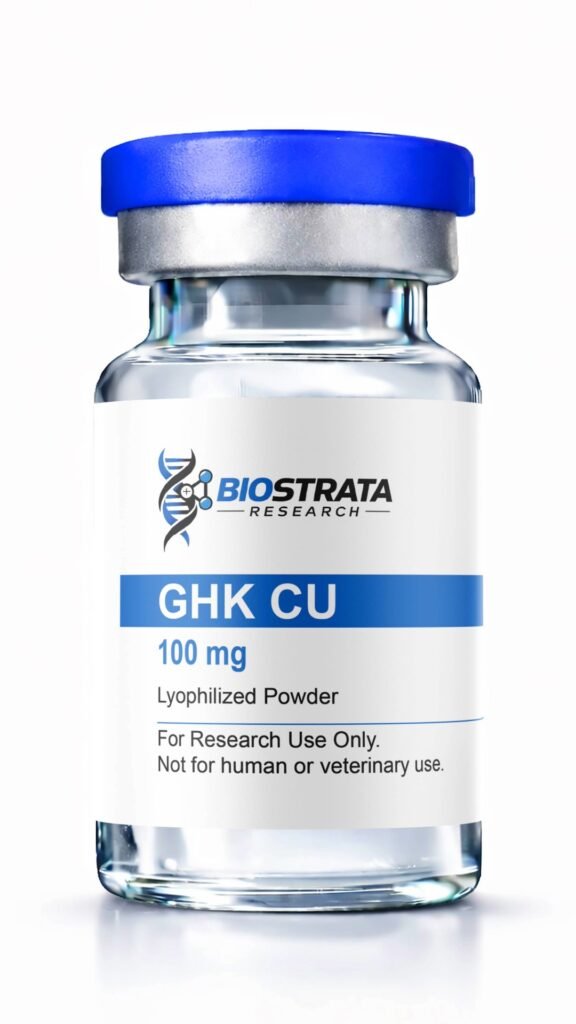
BioStrata Research supplies GHK-Cu and GLOW as research-grade lyophilized compounds with full batch COA documentation for laboratory use only.
FAQs, GHK-Cu Research Overview
What does GHK-Cu stand for?
GHK stands for glycyl-L-histidyl-L-lysine, the three amino acids that make up the peptide in that sequence. Cu is the chemical symbol for copper. GHK-Cu is the peptide in its copper-bound form, which is the biologically active version. The copper component is essential to how the compound works, acting as a delivery mechanism that carries copper to sites where it is needed for collagen assembly and tissue repair.
Is GHK-Cu naturally occurring?
Yes. GHK-Cu is found naturally in human plasma, saliva, and urine throughout life. It was first isolated from human blood in 1973. Plasma concentrations are meaningfully higher in young adults and decline significantly with age, dropping from around 200 ng/ml at age 20 to around 80 ng/ml by age 60. That age-related decline is one of the reasons GHK-Cu has attracted sustained research interest in aging biology.
What is GHK-Cu most studied for?
Skin biology is the core of the research record: collagen and elastin stimulation, wound healing, and fibroblast activation. Human clinical trials have shown improvements in skin density, firmness, and fine lines compared to placebo. The gene expression research, showing effects on over 4,000 human genes, is arguably the most scientifically significant finding in the broader GHK-Cu literature and has opened research directions well beyond skin biology.
How is research-grade GHK-Cu different from cosmetic copper peptides?
Research-grade GHK-Cu is verified to a specific purity standard by HPLC and mass spectrometry testing, with batch-specific documentation confirming exactly what compound was tested and at what concentration. Commercial skincare formulations vary widely in concentration, delivery mechanism, and purity verification. For laboratory research, that level of documentation is essential for producing reproducible results.
How does GHK-Cu compare to TB-500 for tissue repair?
GHK-Cu and TB-500 both appear in tissue repair and healing research but through different mechanisms and with different primary research focuses. GHK-Cu works primarily through copper delivery, collagen stimulation, and gene expression modulation, with its deepest research record in skin biology. TB-500 works through actin regulation and cell migration, with its deepest record in connective tissue and systemic injury models. For a full look at TB-500’s research profile, see TB-500 research overview.
- CONTINUE LEARNING
Explore Related Peptide Topics
Continue building your understanding by exploring related foundational peptide topics.
References & Sources
- Regenerative Actions of GHK-Cu and Tissue Remodeling — PMC
- GHK-Cu and Increased Collagen and Elastin Density in Human Skin — EurekAlert
- GHK-Cu, Copper Transport, and Oxidative Stress Modulation — PMC
All references are provided for educational and research context only. GHK-Cu is an investigational compound and is not approved for general therapeutic use.