
Retatrutide is the first compound to activate three metabolic hormone receptors simultaneously: GLP-1, GIP, and glucagon. That third receptor, the glucagon receptor, is what makes it genuinely different from everything that came before it, and also what makes it the most counterintuitive compound in metabolic research right now. Glucagon raises blood sugar. Adding it to a weight loss compound seems like it should make things worse. The research shows the opposite. For foundational context on the GLP-1 and GIP side of that mechanism, see the tirzepatide research overview before diving into what retatrutide adds on top.
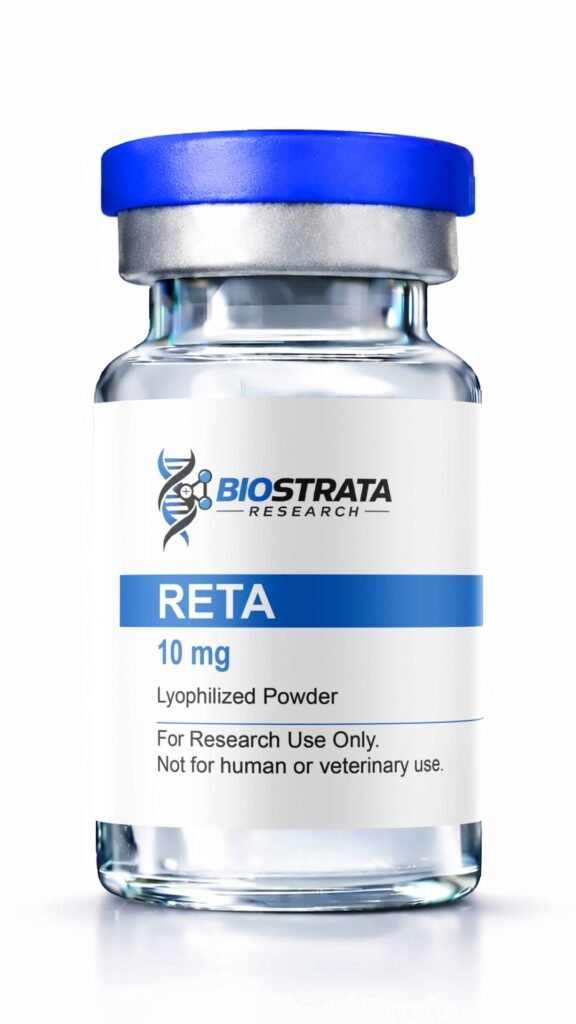
Retatrutide: Key Research Facts
- Retatrutide simultaneously activates GLP-1, GIP, and glucagon receptors, making it the only triple agonist compound currently in clinical research.
- Phase 2 data published in the New England Journal of Medicine showed 24.2% average body weight reduction at 48 weeks with no plateau observed at trial end.
- TRIUMPH-4 Phase 3 results showed 28.7% average weight loss at 68 weeks, the highest ever recorded in a clinical trial for any metabolic compound.
- TRIUMPH-4 also demonstrated a 76% reduction in knee osteoarthritis pain scores, opening a research avenue well beyond metabolic endpoints.
- Seven additional Phase 3 trial readouts are expected in 2026, making retatrutide one of the most closely watched compounds in current metabolic research.
Three Receptors, One Molecule
Every generation of metabolic compound in the last decade has added a receptor. Semaglutide targeted GLP-1 alone and produced around 15% body weight reduction. Tirzepatide added GIP on top of GLP-1 and pushed that to nearly 21%. Retatrutide adds a third receptor, the glucagon receptor, and the early data suggests the gap widens again.
To understand what each receptor contributes, it helps to think of them as three separate dials controlling different aspects of your metabolism. The GLP-1 dial controls appetite and insulin release. Turn it up and you eat less, feel fuller faster, and your blood sugar stays more stable after meals. The GIP dial amplifies what GLP-1 does in the pancreas and adds a second layer of influence over fat tissue metabolism that GLP-1 cannot access alone.
The glucagon dial is the one that surprises people. Glucagon is known for raising blood sugar, which is the opposite of what you want in a metabolic compound. But at a carefully calibrated lower level of activation, glucagon receptor signaling does something different: it increases how much energy the body burns and accelerates the mobilization of stored fat from the liver and adipose tissue. That energy expenditure effect is the mechanism tirzepatide cannot access and the primary reason researchers believe retatrutide is producing meaningfully greater weight loss than its predecessors.
Retatrutide activates all three in a single once-weekly injection. A fatty acid modification extends its half-life long enough to make weekly dosing practical in research models, consistent with the albumin-binding approach used across the incretin class. For a deeper look at how GLP-1 signaling works at the cellular level, see how GLP-1 peptides work.
The Glucagon Paradox: Why Adding a Blood Sugar Raising Hormone Helps You Lose More Weight
Glucagon has a reputation problem in metabolic research. Its primary known function is to raise blood sugar by signaling the liver to release stored glucose. That makes it sound like exactly the wrong thing to add to a compound designed to improve metabolic health. This is the glucagon paradox, and understanding it is key to understanding why retatrutide is producing results that earlier dual agonist compounds cannot match.
The key is dose and context. At the levels glucagon normally circulates during fasting or stress, its blood sugar raising effect dominates. But at a lower, calibrated level of glucagon receptor activation running alongside active GLP-1 and GIP signaling, the picture changes. GLP-1 receptor activation is already suppressing glucagon release from pancreatic alpha cells, which keeps the glycemic raising effect of glucagon receptor stimulation in check. The net result is that the blood sugar raising function is largely neutralized while a separate set of glucagon receptor effects remain active.
Those separate effects are what researchers are focused on. Glucagon receptor activation at calibrated doses increases thermogenesis, meaning the body generates and burns more heat and energy. It also accelerates lipolysis, the breakdown and mobilization of stored fat from adipose tissue and the liver. These are energy expenditure mechanisms that operate completely independently of appetite suppression. GLP-1 and GIP reduce how much energy goes in. Glucagon receptor activation increases how much energy gets burned. The combination produces a metabolic effect across both sides of the energy balance equation simultaneously.
This is why researchers watching the Phase 2 data were struck not just by the weight loss numbers but by the absence of a plateau. Semaglutide and tirzepatide both plateau because appetite suppression alone eventually meets the body’s compensatory mechanisms. Adding energy expenditure through a third pathway appears to delay or prevent that ceiling. For context on why GLP-1 compounds plateau and what the underlying biology looks like, see why GLP-1 weight loss plateaus.
What the Research Actually Shows
The primary clinical dataset for retatrutide comes from a Phase 2 trial published in the New England Journal of Medicine in August 2023. It enrolled 338 adults with obesity and no type 2 diabetes and ran for 48 weeks across multiple dose groups.
At the 12mg dose, average body weight reduction was 24.2% at 48 weeks, equivalent to approximately 57.8 pounds. Every participant in the 12mg group lost at least 5% of their body weight. 93% lost at least 10%. 83% lost at least 15%. Those threshold achievement numbers are unlike anything seen in prior metabolic research. The most significant detail in the dataset is what did not happen: there was no plateau by week 48. The weight loss curve was still descending when the trial ended, suggesting the ceiling had not yet been reached.
The first Phase 3 data arrived in December 2025 with TRIUMPH-4, which studied retatrutide in adults with obesity and knee osteoarthritis over 68 weeks. The 12mg group showed 28.7% average weight loss, the highest figure ever recorded in a clinical trial for any metabolic compound. That same group showed a 76% reduction in knee pain scores and significant improvements in physical function. A post-hoc analysis found that 12% of the 12mg group were completely free of knee pain at 68 weeks compared to 4.2% of the placebo group.
Seven additional Phase 3 readouts are expected throughout 2026 across obesity, type 2 diabetes, sleep apnea, and cardiovascular disease indications. That makes 2026 the most data-rich year retatrutide research has seen and the period that will determine whether Phase 3 results hold at the scale needed for regulatory review. For a comparison of where these numbers sit relative to semaglutide and tirzepatide at equivalent timepoints, see tirzepatide vs semaglutide.
Side Effects: What the Data Shows So Far
Retatrutide’s side effect profile in Phase 2 is broadly consistent with the GLP-1 class. Nausea, diarrhea, vomiting, and constipation are the most commonly reported adverse events, concentrated during the dose escalation phase and dose-dependent across groups. These are mechanistically predictable and follow the same pattern seen with semaglutide and tirzepatide.
One finding worth noting from Phase 2: starting at a lower initial dose of 2mg rather than 4mg significantly reduced early gastrointestinal discontinuation rates without affecting long-term weight loss outcomes. That finding shaped the TRIUMPH Phase 3 escalation protocol and reinforces what has become consistent across incretin research: the escalation schedule is not administrative procedure, it is an active part of how the compound is meant to work.
TRIUMPH-4 introduced a side effect not prominently seen in earlier incretin research: dysesthesia, an abnormal skin sensation described as tingling or prickling. It was reported in up to 20.9% of participants in the 12mg group, compared to 0.7% in the placebo group. The events were generally mild and rarely led to discontinuation, but it is a signal that distinguishes retatrutide from its predecessors and one researchers are monitoring closely in ongoing trials. The mechanism behind it is not yet fully understood and represents an active area of investigation.
An important context note: retatrutide has only completed one Phase 3 trial. The long-term safety picture that exists for semaglutide, built across 17,604 participants over nearly four years in the SELECT trial, does not yet exist for retatrutide. The TRIUMPH program will build that dataset over the next several years. For a class-level breakdown of how GLP-1 compound side effects compare across generations, see GLP-1 peptides: common side effects observed in research.
Retatrutide in the Research Landscape
Retatrutide is at an unusual stage for a research compound. It has enough clinical data to be genuinely compelling and not enough to be fully characterized. That combination makes it one of the most actively studied compounds in metabolic research right now and one of the most interesting from a mechanistic standpoint.
For researchers, the open questions around triple receptor agonism are significant. How does simultaneous activation of all three receptors influence energy expenditure pathways over the long term? Does glucagon receptor activation at calibrated doses remain metabolically favorable as the body adapts over years rather than months? How does adipose tissue respond to triple receptor activation differently than it does to dual agonism? These are not settled questions and retatrutide is the primary tool being used to investigate them.
The no-plateau finding across both Phase 2 and the first Phase 3 readout is the detail researchers are watching most closely. If that pattern holds across the full TRIUMPH program, it suggests the ceiling on what metabolic compounds can achieve through receptor-based signaling is higher than current approved compounds have reached. That has implications not just for retatrutide but for the entire next generation of metabolic peptide design. For context on what happens biologically when any compound in this class is discontinued and what the weight regain data shows, see what happens when you stop peptides. For a broader look at how cellular energy signaling systems fit within the larger metabolic research landscape, see metabolic and energy research. For how AI-driven computational tools are accelerating the design of the next generation of multi-receptor compounds beyond what retatrutide has established, see how AI is changing peptide discovery and design.
BioStrata Research supplies retatrutide 10mg as a verified research-grade compound with full batch-specific analytical documentation. For researchers building comparative metabolic research protocols, tirzepatide 10mg is also available as the dual agonist predecessor compound. All products are strictly for laboratory research use only.
Frequently Asked Questions
What makes retatrutide different from tirzepatide and semaglutide?
Retatrutide activates three receptors simultaneously: GLP-1, GIP, and glucagon. Semaglutide targets only GLP-1. Tirzepatide targets GLP-1 and GIP. The glucagon receptor addition introduces energy expenditure mechanisms that neither predecessor can access, which researchers believe is the primary driver of retatrutide’s greater weight loss outcomes. For the full dual agonist mechanism, see the semaglutide research overview.
How much weight loss does retatrutide produce?
Phase 2 data showed 24.2% average body weight reduction at 48 weeks with no plateau observed at trial end. TRIUMPH-4 Phase 3 data showed 28.7% average weight loss at 68 weeks, the highest figure ever recorded in a clinical trial for any metabolic compound. Results vary by dose and participant profile.
What is dysesthesia and why does it appear with retatrutide?
Dysesthesia is an abnormal skin sensation, typically described as tingling or prickling. It was reported in up to 20.9% of TRIUMPH-4 participants at the 12mg dose, compared to 0.7% in the placebo group. Events were generally mild and rarely led to discontinuation. The mechanism behind it is not yet fully understood and is an active area of investigation in ongoing TRIUMPH trials.
Why does retatrutide not plateau the way semaglutide and tirzepatide do?
Semaglutide and tirzepatide plateau because appetite suppression alone eventually meets the body’s compensatory mechanisms. Retatrutide’s glucagon receptor activation adds energy expenditure and fat mobilization through a completely separate pathway, which appears to delay or prevent that ceiling. Neither the Phase 2 nor TRIUMPH-4 data showed a plateau at trial end. For the full biology of why GLP-1 compounds plateau, see peptides and weight loss.
Is retatrutide FDA approved?
No. Retatrutide is currently in Phase 3 clinical trials under the TRIUMPH program. TRIUMPH-4 results were announced in December 2025. Seven additional Phase 3 readouts are expected in 2026. If trials are positive and Eli Lilly submits a New Drug Application, FDA review would follow, placing potential approval several years away. All BioStrata Research compounds are for laboratory research use only.
- CONTINUE LEARNING
Explore Related Peptide Topics
Continue building your understanding by exploring related foundational peptide topics.
References & Sources
- Triple-Hormone-Receptor Agonist Retatrutide for Obesity: A Phase 2 Trial — New England Journal of Medicine
- Efficacy of GLP-1 Analog Peptides, Semaglutide, Tirzepatide and Related Agents in Metabolic Control — Nature
- Discovery of Peptides as Key Regulators of Metabolic and Energy Homeostasis — PMC
- Tirzepatide vs Semaglutide for Treatment of Obesity (SURMOUNT-5 Trial) — New England Journal of Medicine
- Once-Weekly Semaglutide in Adults With Overweight or Obesity (STEP 1 Trial) — New England Journal of Medicine