
MOTS-c has been called exercise in a bottle. That description is an oversimplification, but it captures something real about what makes this peptide scientifically interesting. MOTS-c is a signaling molecule your own mitochondria produce in response to exercise and metabolic stress. It rises in your bloodstream when you work out, declines as you age, and appears to communicate the metabolic benefits of physical activity to tissues throughout the body.
This overview covers what MOTS-c is, what the research shows about its effects on metabolism, insulin sensitivity, exercise performance, and aging, and why it occupies a genuinely unique position in the peptide research landscape. All research discussed here was conducted in laboratory and animal models unless otherwise noted. MOTS-c is classified as Research Use Only. For the latest developments in MOTS-c mitochondrial research, see MOTS-c mitochondrial study 2026.
MOTS-C Research: Mitochondrial Science at a Glance
- MOTS-C is encoded by mitochondrial DNA — not nuclear DNA — making it one of the only known peptides with a mitochondrial origin
- Its primary mechanism is AMPK activation — the same energy-sensing pathway triggered by exercise and caloric restriction
- MOTS-C levels rise in plasma during exercise and decline with age — positioning it as both a biomarker and active mediator of metabolic healths
- Skeletal muscle is its primary target tissue — MOTS-C improves glucose uptake and insulin sensitivity through AMPK-driven mechanisms in muscle cells
- Research in aging models links MOTS-C to cellular stress response and longevity — centenarian populations show measurably different MOTS-C profiles than age-matched controls
What MOTS-c Is and Why It Is Unlike Other Research Peptides
Most peptides are encoded by nuclear DNA, the genetic material housed in the cell’s nucleus. MOTS-c is different. It is encoded by mitochondrial DNA, the separate genetic material housed inside mitochondria, the energy-producing structures in every cell. This makes MOTS-c one of a handful of known peptides with a mitochondrial origin, a class of molecules so recently discovered that researchers are still mapping what they do and how they work.
Mitochondria were long thought to be passive energy factories. Their job was to convert food into ATP, the molecule cells use for energy, and not much else. The discovery that mitochondria also produce signaling peptides that communicate with the rest of the cell and with distant tissues changed that picture significantly. MOTS-c, discovered in 2015 by researchers at the University of Southern California, was one of the first mitochondrial peptides found to have systemic effects, meaning it travels beyond the cell that produces it and influences biology throughout the body.
MOTS-c is 16 amino acids long. It is produced inside mitochondria, released into the cell, and can enter the bloodstream where it reaches tissues including skeletal muscle, the liver, and fat tissue. Research has found it acts like a hormone-like signal, telling distant tissues to shift into a more metabolically efficient state in response to energy demand.
What makes this origin story matter for research is the direct connection between mitochondrial health and MOTS-c production. As mitochondria become less efficient with age, MOTS-c production declines. That decline may be both a consequence of mitochondrial aging and a contributor to the metabolic changes that follow. For foundational context on what peptides are and how signaling molecules like MOTS-c influence cellular function, see what do peptides do.
How MOTS-c Works: The Exercise Connection Explained
The core mechanism behind MOTS-c involves a molecule called AMPK, AMP-activated protein kinase. AMPK is often described as the cell’s master energy sensor. When the cell is running low on energy, whether from exercise, fasting, or metabolic stress, AMPK switches on and triggers a set of adaptations designed to help the cell cope: burn more fat, use glucose more efficiently, reduce energy-consuming processes, and improve mitochondrial function.
MOTS-c activates AMPK. That single fact explains most of what the research shows about it. By switching on the cell’s energy sensor, MOTS-c essentially tells the cell to behave as if it is exercising, even in the absence of physical activity. This is why researchers have described it as an exercise mimetic, a compound that reproduces at least some of the metabolic signals that exercise generates.
The exercise connection goes deeper than mechanism. Research has measured MOTS-c levels in human blood before and after physical activity. During exercise, MOTS-c levels in skeletal muscle increased nearly 12-fold, and circulating levels in blood rose by about 1.5 times. After four hours of rest, levels returned toward baseline. The body produces more MOTS-c during exercise and the signal dissipates when exercise stops, exactly the pattern you would expect from a compound that communicates exercise-induced metabolic signals to tissues throughout the body.
The practical research implication is significant. If MOTS-c is part of how the body communicates the metabolic benefits of exercise to distant tissues, then declining MOTS-c levels with age may help explain why older adults experience reduced metabolic flexibility, slower recovery, and diminished response to the same exercise stimuli that produced strong adaptations in younger years. For research on how metabolism and weight biology connect to MOTS-c’s exercise mimetic effects, see peptides and weight loss.
Insulin Sensitivity, Fat Metabolism, and the Diabetes Research Connection
Beyond the exercise connection, MOTS-c has been studied extensively in metabolic disease models, and the findings in this area are among the most striking in the literature. Skeletal muscle is responsible for the majority of glucose uptake in response to insulin, and impaired muscle glucose metabolism is a central feature of insulin resistance, the condition that precedes type 2 diabetes.
Research in rodent models found that MOTS-c administration improved insulin sensitivity, enhanced glucose uptake in skeletal muscle, and reduced fat accumulation. One landmark study found that MOTS-c prevented obesity in mice fed a high-fat diet, not by reducing how much they ate, but by improving how their cells processed the energy they consumed. That is a metabolically specific effect that points directly to AMPK-mediated changes in cellular energy metabolism rather than appetite suppression.
The comparison to metformin has come up repeatedly in the MOTS-c literature. Metformin is one of the most widely prescribed diabetes medications in the world, and it works largely through AMPK activation. Researchers have noted that MOTS-c has physiological similarities to metformin in terms of how it manages glucose utilization and body weight. The key difference is target tissue. Metformin acts primarily on the liver. MOTS-c acts primarily on skeletal muscle. They share a mechanism but address different points in the metabolic system.
Age-related insulin resistance has been another focus. A study found that seven days of MOTS-c administration in old mice restored their insulin sensitivity to levels seen in young, healthy mice, a finding that generated significant research interest in the aging and metabolic medicine communities. For broader context on how cellular energy signaling systems intersect with metabolic research, see metabolic and energy research: understanding cellular energy signaling.
Aging Research: What Centenarians and Old Mice Tell Us
MOTS-c’s origins in mitochondrial DNA give it a unique angle in aging research. Mitochondrial function declines with age. Mitochondria become less efficient, produce more oxidative damage, and communicate less effectively with the rest of the cell. Since MOTS-c is a mitochondrial signal, the age-related decline in MOTS-c levels may be both a consequence and a contributor to the metabolic changes associated with aging.
The landmark 2021 Nature Communications study examined this directly. Researchers administered MOTS-c to mice across three different age groups: young at two months, middle-aged at twelve months, and old at twenty-two months. Physical performance improved across all three groups, but the effect was most striking in the oldest mice, where MOTS-c administration improved exercise capacity and metabolic function in ways that resembled the effects of regular physical training. Late-life treatment initiated when mice were equivalent in age to a human in their late seventies showed measurable improvements in physical capacity and healthspan.
Research has also found differences in MOTS-c levels between people who live to one hundred or older and age-matched controls. Some centenarian populations, particularly in Japan, show higher MOTS-c levels and specific genetic variants in the MOTS-c gene region. This is observational data, not causal evidence, but it has reinforced interest in MOTS-c as a potential biomarker of metabolic health and biological aging rather than just chronological age.
MOTS-c also acts as a stress response signal. When cells face metabolic challenges including oxidative stress, glucose deprivation, or mitochondrial dysfunction, MOTS-c production increases as part of the cellular response. This has led researchers to characterize it as part of the mitochondrial stress signaling system, a molecular alarm that mobilizes cellular defenses when energy metabolism is under strain. For a related compound studied in immune aging and thymic function decline, see thymosin alpha-1 research overview.
Muscle Performance, Physical Capacity, and What the Research Shows
Skeletal muscle is the primary target tissue for MOTS-c in research, and muscle performance is where the most direct and measurable effects have been documented. Muscle tissue is rich in mitochondria because of its high energy demand, which makes it both a major site of MOTS-c production and the tissue most directly affected by MOTS-c signaling.
Research has found that MOTS-c may protect against the weakening of muscle strength associated with aging by blocking myostatin, a protein that inhibits muscle growth and maintenance. In aging muscle, myostatin activity increases and contributes to the gradual loss of muscle mass and function that characterizes sarcopenia. MOTS-c’s ability to counter this signal in animal models has made it relevant to research on age-related muscle decline beyond its metabolic and insulin sensitivity applications.
The treadmill performance data from the 2021 Nature Communications study showed approximately two-fold improvements in exercise capacity across all age groups of mice treated with MOTS-c. In the oldest mice, that improvement is particularly significant because it suggests MOTS-c can partially restore physical capacity even when initiated late in life, not just as a preventative measure in younger animals.
MOTS-c appears on the WADA Prohibited List under Section 4 as an AMPK activator, banning its use in competitive sports at all times. It is classified as Research Use Only in the United States and is not approved by the FDA for human therapeutic use. No human clinical trials for MOTS-c as a therapeutic compound have been published.
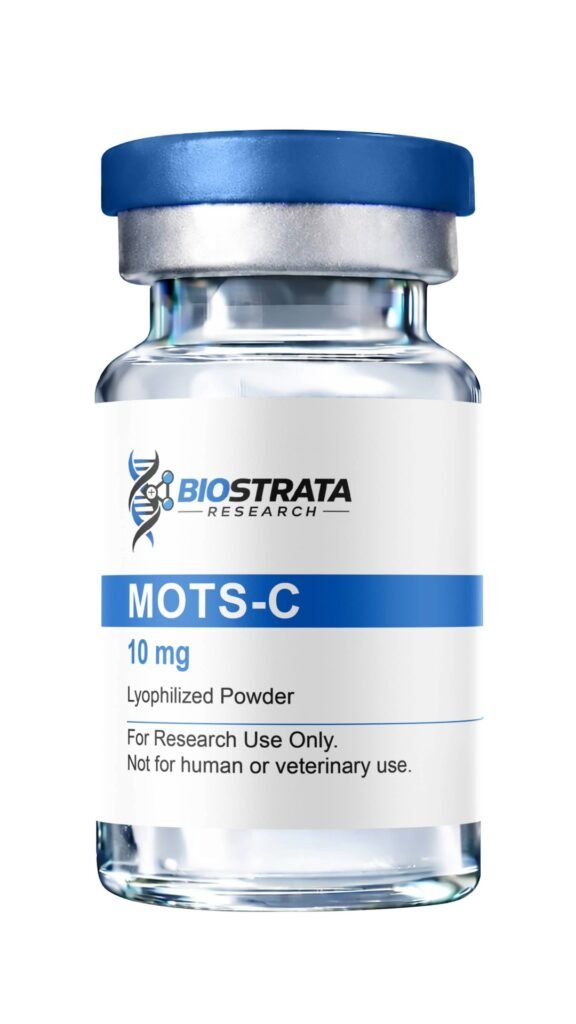
BioStrata Research supplies MOTS-c as a research-grade lyophilized compound with full batch COA documentation for laboratory use only. For guidance on handling lyophilized compounds and reconstitution best practices, see lyophilized vs reconstituted peptides. For the full range of research compounds, see the BioStrata Research shop.
FAQs, MOTS-c Research Overview
What is MOTS-c and why is it called the exercise mimetic peptide?
MOTS-c is a 16-amino-acid peptide encoded by mitochondrial DNA and produced in response to exercise and metabolic stress. It activates AMPK, the same cellular energy switch triggered by physical activity, which causes cells to burn fat more efficiently, improve insulin sensitivity, and adapt to energy demands. Because it reproduces some of the metabolic signals that exercise generates, researchers have described it as an exercise mimetic, a compound that communicates exercise-like metabolic adaptations to tissues throughout the body.
How does MOTS-c differ from other metabolic peptides like GLP-1?
GLP-1 peptides work primarily through pancreatic insulin secretion and appetite suppression via brain signaling. MOTS-c works at the cellular level through AMPK activation, improving how individual cells process energy rather than regulating hormone release or food intake. They target different points in the metabolic system and are studied in different research contexts. MOTS-c’s primary target is skeletal muscle. GLP-1’s primary targets are the pancreas and brain.
Why does MOTS-c decline with age?
MOTS-c is produced by mitochondria, and mitochondrial function declines with age. As mitochondria become less efficient and produce fewer signaling molecules, MOTS-c levels in circulation fall. Research has found that circulating MOTS-c can be measurably lower in older adults compared to younger counterparts, and that this decline tracks with reduced metabolic flexibility and physical capacity. Whether supplementing MOTS-c can offset this age-related decline is an active area of research.
What did the 2021 Nature Communications study find?
Researchers found that MOTS-c levels rise significantly in skeletal muscle and blood during exercise in humans. When synthetic MOTS-c was administered to mice across three age groups, physical performance improved in all groups with the most striking effects in the oldest mice. Late-life initiated MOTS-c treatment improved exercise capacity and healthspan, suggesting the compound can partially restore physical function even when started later in life.
Is MOTS-c similar to metformin?
Both activate AMPK, the cellular energy sensor, which is why researchers have noted physiological similarities between the two in terms of how they manage glucose utilization and body weight. The key difference is where they act. Metformin acts primarily on the liver. MOTS-c acts primarily on skeletal muscle. They share a mechanism but target different tissues, which means they address different aspects of metabolic dysfunction. For broader context on how longevity-focused peptide research intersects with metabolic aging, see longevity and healthy aging research, muscle and performance research, and immune and inflammatory response research. For the latest research developments, see MOTS-C mitochondrial study 2026.
- CONTINUE LEARNING
Explore Related Peptide Topics
Continue building your understanding by exploring related foundational peptide topics.
References & Sources
- MOTS-c Promotes Metabolic Homeostasis and Reduces Obesity and Insulin Resistance — Cell Metabolism
- Exercise-Induced Regulation of MOTS-c and Metabolic Adaptation — Nature Communications
- MOTS-c Translocation to the Nucleus and Regulation of Cellular Stress Response — Cell Metabolism
- MOTS-c, Diabetes, and Aging: Metabolic Implications — Diabetes & Metabolism Journal
All references are provided for educational and research context only. Compounds discussed are investigational and not intended for general therapeutic use.