TB-500 is one of the most studied peptides in tissue repair and regenerative biology research. It is a synthetic fragment of Thymosin Beta-4, a protein the body naturally produces in response to injury, and it has been examined across wound healing, tendon repair, cardiac recovery, and inflammatory models in preclinical research. It is frequently studied alongside BPC-157 because the two compounds work through different but complementary mechanisms in the repair process.
All research discussed here was conducted in laboratory and animal models. TB-500 is classified as Research Use Only and has not been approved by the FDA for human therapeutic use. For the parallel research profile of the compound most commonly studied alongside TB-500, see BPC-157 research overview.
Key Research Facts: TB-500 Research Overview
- TB-500 is a synthetic 7-amino-acid peptide derived from the actin-binding domain of Thymosin Beta-4, a naturally occurring protein found in virtually every mammalian cell
- Its primary studied mechanism is G-actin sequestration, regulating the availability of actin monomers that cells need to migrate into injured tissue and begin repair
- Tissue repair, wound healing, cardiac recovery, and anti-inflammatory effects have all been examined in preclinical models across independent research groups
- Full-length Thymosin Beta-4 has progressed to Phase II human clinical trials for corneal wound healing, TB-500 as a synthetic fragment remains primarily preclinical
- TB-500 appears on the WADA Prohibited List and is classified as Research Use Only, it is not approved by the FDA for human therapeutic use
What TB-500 Is and How It Relates to Thymosin Beta-4
TB-500 is a synthetic peptide corresponding to a specific 7-amino-acid segment of Thymosin Beta-4, a protein found in virtually every mammalian cell. Thymosin Beta-4 is one of the most abundant intracellular peptides in human biology, with the highest concentrations in platelets, macrophages, and wound fluid. That distribution is not coincidental. The body concentrates Thymosin Beta-4 in exactly the places where tissue damage and repair are most likely to occur.
TB-500 is not identical to Thymosin Beta-4. It is a shorter synthetic fragment designed to isolate and study the biological activity of one specific region of the larger protein, the actin-binding domain. Researchers work with shorter fragments because they are more consistent to produce, more stable in laboratory conditions, and allow more targeted investigation of a specific mechanism. Findings from the broader Thymosin Beta-4 literature, including clinical trial data, do not automatically transfer to TB-500 without direct comparative study.
Understanding the difference between the two matters when reading the research. Studies on full-length Thymosin Beta-4 tell you something about the protein as a whole. Studies on TB-500 tell you specifically about the actin-binding region. The two overlap but are not interchangeable, and conflating them is one of the most common errors in how TB-500 research gets summarized in secondary sources.
TB-500 is classified as Research Use Only. It has not completed the clinical trial process required for pharmaceutical approval and is not approved for human therapeutic use. For context on the longevity and aging research applications where Thymosin Beta-4 class compounds have generated sustained interest, see longevity and healthy aging research.
How TB-500 Works: The Actin Mechanism Explained Simply
The mechanism behind TB-500 comes down to one protein: actin. Actin is the structural protein that physically drives cell movement. Think of it like a molecular motor. When a cell needs to move, it rapidly assembles actin units at its leading edge and pushes itself forward. That is what powers cell migration, and cell migration is what starts the repair process after an injury.
Inside every cell, actin exists in two states: free-floating individual units that are ready to be assembled, and assembled chains that are actively doing work. TB-500’s role is to manage the pool of free-floating units, keeping them available and ready to be mobilized the moment a cell receives a signal to move. In an injury context, that signal fires when tissue is damaged and cells need to move into the wound site. The more efficiently that happens, the faster repair begins.
TB-500 also appears to activate enzymes that clear structural debris in damaged tissue. After an injury, the scaffolding between cells can become disorganized and physically block the path cells need to travel. These enzymes help clear that path, making it easier for repair cells to get where they need to go. This is thought to work alongside the actin mechanism rather than separately from it.
TB-500 also promotes the formation of new blood vessels, which gives injured tissue the circulation it needs to sustain repair over time. This is a different entry point than BPC-157 uses, but it produces a similar outcome: more blood supply to the injury site. For context on how inflammatory signaling interacts with these repair mechanisms, see immune and inflammatory response research.
Tissue Repair and Wound Healing: What the Research Shows
The most substantial body of TB-500 research involves wound healing and connective tissue repair across multiple injury types. In dermal wound models, Thymosin Beta-4 has been shown to accelerate wound closure by promoting the migration of keratinocytes, the skin cells responsible for re-covering a surface wound. Multiple studies have documented faster reepithelialization in treated animals compared to controls, with cell migration as the proposed driver.
Corneal wound research has been another significant area. Studies demonstrating accelerated epithelial closure and reduced inflammation in corneal injury models ultimately supported Phase II clinical trials by RegeneRx Biopharmaceuticals investigating topical Thymosin Beta-4 formulations for dry eye and corneal repair. This is one of the few areas where the research has advanced beyond rodent models, though those trials used full-length Thymosin Beta-4 rather than TB-500 specifically.
Musculoskeletal research has examined TB-500 in tendon, ligament, and muscle injury models, frequently alongside BPC-157. These studies have investigated inflammatory markers, collagen organization, and structural recovery in injured tissue. The two compounds are often studied together because their mechanisms are complementary rather than overlapping. TB-500 drives cell migration through actin regulation. BPC-157 drives blood supply through VEGF upregulation. Together they address two different bottlenecks in the repair process. For a broader look at the compounds and mechanisms studied across tissue repair and performance recovery categories, see healing and regenerative research and muscle and performance research.
For a look at how the GHK-Cu research profile compares as another compound studied across healing and tissue remodeling applications, see GHK-Cu research overview.
Cardiac and Anti-Inflammatory Research
Beyond wound and tissue repair, Thymosin Beta-4 has been studied in cardiac recovery models with results compelling enough to sustain serious research interest. Studies in rodent models of heart attack have investigated whether Thymosin Beta-4 can help heart muscle cells survive, limit the size of the damaged area, and reactivate repair cells in the heart that are normally dormant in adults.
Research has found that these heart repair cells are active during fetal development but switch off after birth. Studies showed that administering Thymosin Beta-4 in adult mice was capable of switching those cells back on, a finding that generated significant interest in cardiac regeneration research. This work remains preclinical for TB-500 specifically, but it is one of the more developed areas of the broader Thymosin Beta-4 literature.
Anti-inflammatory activity is a separate but related research thread. Studies have found that Thymosin Beta-4 reduces the production of the signaling molecules that drive inflammation in injured tissue. Sustained or excessive inflammation is a primary driver of impaired healing, so this anti-inflammatory action may work alongside the cell migration and blood vessel effects to support tissue recovery rather than compete with it.
TB-500 has also been investigated in neurological contexts, with rodent studies examining its role in neuroprotection and recovery following central nervous system injury. These findings are newer and less established than the wound healing literature but represent an active area of investigation. For the latest developments in copper peptide research which shares some overlap with TB-500’s tissue applications, see GHK-Cu copper peptide research 2026.
Regulatory Status, WADA Classification, and Research Supply
TB-500 is not approved by the FDA for human therapeutic use. It was designated a Category 2 bulk drug substance, meaning compounding pharmacies are prohibited from including it in preparations intended for human administration. This designation does not affect its availability as a Research Use Only compound for laboratory and analytical use, but it reflects an evolving regulatory approach to peptides that researchers working in this space should understand clearly.
TB-500 also appears on the World Anti-Doping Agency Prohibited List, meaning it is banned in competitive sports both in and out of competition. This classification is separate from its research status. A compound can be legally supplied for laboratory research while simultaneously being prohibited in athletic competition, and that distinction matters for anyone interpreting TB-500’s regulatory standing in different contexts.
No published human clinical trials exist for TB-500 as a synthetic fragment. Full-length Thymosin Beta-4 has been evaluated in Phase II trials for corneal applications, but those findings do not automatically transfer to TB-500 without direct comparative research. The preclinical record is substantial and internally consistent, but the human translation question remains open.
For context on why some research compounds show strong preclinical results but variable long-term activity, see why some peptides stop working: what’s actually happening.
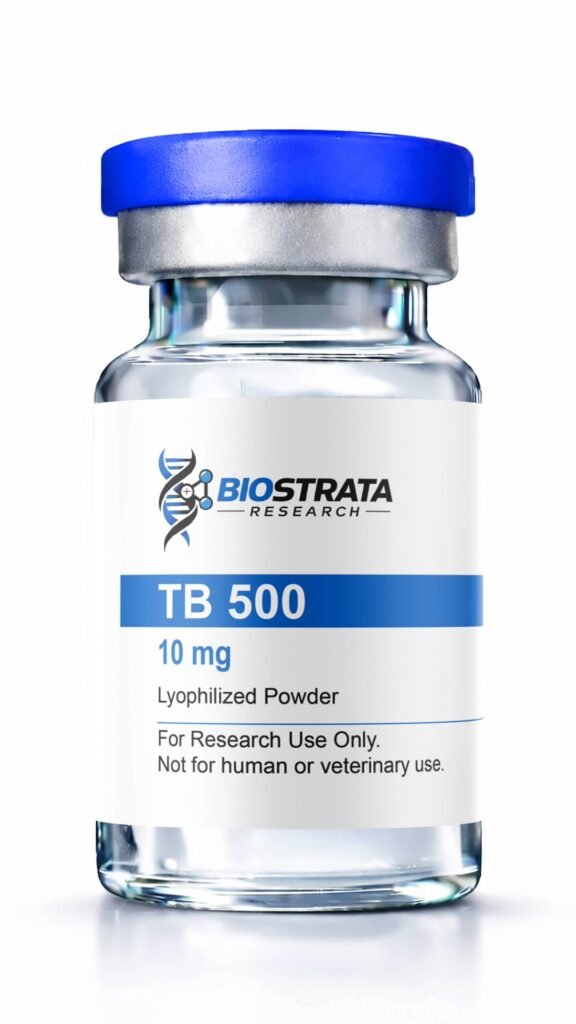
BioStrata Research supplies TB-500 as a research-grade lyophilized compound with full batch COA documentation for laboratory use only.
FAQs, TB-500 Research Overview
What is the difference between TB-500 and Thymosin Beta-4?
Thymosin Beta-4 is a naturally occurring 43-amino-acid protein found in virtually every mammalian cell. TB-500 is a synthetic 7-amino-acid fragment corresponding specifically to the actin-binding domain of that protein, amino acids 17 through 23. The two share overlapping but not identical research profiles. Findings from full-length Thymosin Beta-4 studies, including clinical trial data, do not automatically apply to TB-500 without direct comparative research.
How does TB-500 work for tissue repair?
TB-500 regulates the availability of G-actin, the individual units that cells assemble into structural chains when they need to move. By maintaining a ready pool of actin monomers, TB-500 supports faster and more efficient cell migration into injured tissue, which is one of the first steps in the repair process. It also upregulates enzymes that clear structural barriers in damaged tissue and promotes new blood vessel formation.
Why is TB-500 often studied with BPC-157?
The two compounds work through different mechanisms that address different bottlenecks in tissue repair. TB-500 drives cell migration through actin regulation. BPC-157 drives blood supply through VEGF upregulation and angiogenesis. Researchers study them together to investigate whether combined effects differ from either compound alone, since they target complementary steps in the same repair process.
Has TB-500 been tested in humans?
TB-500 specifically as a synthetic fragment has a primarily preclinical research profile. Full-length Thymosin Beta-4 has been evaluated in Phase II clinical trials for corneal wound healing, but those findings do not automatically transfer to TB-500. No published human clinical trials for TB-500 exist. All current evidence comes from cell culture and animal model studies.
Is TB-500 legal?
TB-500 is classified as Research Use Only in the United States and is legal for laboratory research supply. It is designated a Category 2 bulk drug substance by the FDA, meaning it cannot be used in compounded preparations for human administration. It also appears on the WADA Prohibited List, banning its use in competitive sports. For a full explanation of what these classifications mean in practice, see are peptides safe.
- CONTINUE LEARNING
Explore Related Peptide Topics
Continue building your understanding by exploring related foundational peptide topics.
References & Sources
- Thymosin Beta-4: Functions and Research Applications — Frontiers in Pharmacology (2022)
- Thymosin Beta-4 Peptide and Dermal Wound Repair in Diabetic and Aged Models — Wound Repair and Regeneration (2003)
- Thymosin Beta-4 in Corneal Wound Healing and Anti-Inflammatory Research — Clinical Ophthalmology (2009)
- Therapeutic Peptides in Orthopaedic Research: Applications and Future Directions — JAAOS (2025)
Disclaimer: BioStrata Research provides materials for laboratory research use only. The information in this article is intended strictly for educational and informational purposes within a research context and should not be interpreted as medical advice, treatment guidance, or product claims for human use.